On 14 September 2026 I took part, in Tallinn (Estonia), in the ETSI ESI Certification Authority (CA) Open Session. I went as an attendee, but by the end of the afternoon I ended up on the panel as a speaker.
The slot had been planned for Steffen Schwalm, who in the end could not attend, and I was asked to step in to talk about how the standardisation of distributed ledger technologies (DLT) is evolving and, in particular, about what we are beginning to call qDLT: the qualified distributed ledger.
I was glad to accept, although (given the short time available to think about what to say) I told my own ideas, not those of the announced speaker.
And in this summary I set out those ideas about what is happening in the standardisation of DLTs: not so much a technological revolution arriving from outside to reinvent digital trust, but a very coherent evolution of something we have been building in Europe for almost a decade. The line of reasoning runs from the preservation of qualified signatures and seals to the ordering of archived files with respect to the moment their custody was requested from the Trust Service Provider. This is how I see it.
The starting point: preserving qualified electronic signatures and seals
The first piece is the one that has been standardised longest, and the one we sometimes forget to mention when we talk about blockchain as if it were virgin territory. Under the umbrella of the first eIDAS, ETSI developed the standard TS 119 511 (the one we usually cite simply as «511») which sets the policy and security requirements for providers offering long-term preservation of electronic signatures (or of data in general) using digital-signature techniques. Its companion, TS 119 512, defines the protocols for interoperating with those preservation services. This first variant (the qualified preservation of qualified electronic signatures and qualified electronic seals) already has its own implementing act: Commission Implementing Regulation (EU) 2025/1946, adopted on the basis of Articles 34(2) and 40 of the eIDAS Regulation. It is worth noting that these are original eIDAS articles, plain numbers, with none of the letter suffixes (Article 45a, 45b, 45c…) that English-language EU legislation uses to mark the provisions eIDAS2 kept inserting; its annex points to ETSI TS 119 511 (together with TS 119 172-4) as the reference standard.
The problem 511 solves is subtle but enormous: an electronic signature is valid today because the certificate backing it is still in force, because the cryptographic algorithms used are considered robust, and because there is an infrastructure that confirms it. But time erodes all of that. Certificates expire, authorities change, and (increasingly relevant ) algorithms age. A qualified preservation service keeps the evidence alive: it periodically reasserts integrity and validity through new time stamps or preservation techniques (such as chained hashes) and new layers of cryptographic protection, so that twenty years from now one can still prove that the document was signed and has not been altered.
This is worth pausing on, because it is exactly the ground where crypto-agility and post-quantum cryptography stop being an academic debate. Preserving for the long term means, by definition, surviving the moment when today’s algorithms cease to be trustworthy. A good preservation service is, at heart, a machine designed to migrate algorithms without losing the evidentiary thread. Whoever understands 511 already understands half of why the rest of this story matters.
The second step: qualified electronic archiving
The second eIDAS (Regulation (EU) 2024/1183) threw nothing away. It broadened. Among the new qualified trust services appears qualified electronic archiving, abbreviated in English jargon as q-earchiving, which in the European standardisation work relies on the technical specification CEN/TS 18170. Its implementing act is Commission Implementing Regulation (EU) 2025/2532, of 16 December 2025, adopted on the basis of Article 45j(2) of the Regulation (the provision eIDAS2 added for qualified electronic archiving) whose annex points precisely to CEN/TS 18170:2025 as the reference standard.
The difference with signature preservation is one of scope. 511 focuses on maintaining the validity of the cryptographic evidence of a signed document. Qualified archiving goes a step further and deals with the document as an object that must be kept intact, legible and available over time, whether signed or not, including the guarantee of its integrity, the traceability of access, and retention policies. It is the regulatory translation of a very old need — the archive — into the language of qualified trust services. For the first time, a provider can offer archiving with the same level of legal assurance already enjoyed by the signature, the seal or the time stamp.
And it is worth clearing up a common misunderstanding: archiving does not replace signature preservation, it relies on it. 511 remains the piece that guarantees the survival of the signature evidence, so a qualified electronic archiving provider can use the services of a preservation provider for that part, turning to a 511 service to keep alive the signatures and seals of the documents it holds. These are not competing services but complementary ones: archiving orchestrates the custody of the file and delegates to preservation the long-term care of the cryptographic evidence. It is exactly the layered logic that runs through this whole article.
There is also a second function of archiving worth highlighting, because it often goes unnoticed: format conversion. Keeping a document for decades is not only about its bits not changing; it is about it remaining legible. And formats age too. A file format that is universal today may become obsolete and fall out of use in favour of others, and when that happens the archiving service must be able to convert the document to the new format while preserving its content, its faithful rendering and its evidentiary value. It is, in the realm of formats, the exact parallel of what preservation does in the realm of algorithms: just as a 511 service migrates cryptographic algorithms before they cease to be trustworthy, an archiving service migrates formats before they cease to be openable. Future legibility of the data and future robustness of the cryptography are two sides of the same promise: that twenty years from now the document will not only exist, but can be opened and proven.
If preservation protects the signature, archiving protects the file. And the next step is to ask what happens when what we need to protect is not an isolated document, but the relationship among many facts over time.
The third step: temporal ordering
Here comes the most interesting novelty of the second eIDAS: electronic ledgers as a new qualified trust service. The reference specification is CEN/TS 18264, published in 2025.
And its implementing act, from the same December 2025 batch, is Commission Implementing Regulation (EU) 2025/2531, adopted on the basis of Article 45l(3) of the Regulation (the provision eIDAS2 devoted to qualified electronic ledgers).
I prefer to explain it with a simple idea: an electronic ledger is a chronologically ordered archive. It does not merely store data entries; it guarantees their temporal sequence in such a way that none can be inserted, deleted or reordered without it showing. It is, if you like, time-stamping raised to the level of a structure: we do not mark a single document with a date, but build a chain of events whose ordering is itself the proof.
And once we accept that what adds value is the guaranteed chronological ordering, the technical question that gives the session its name arises: how is that order built? And there are two legitimate answers.
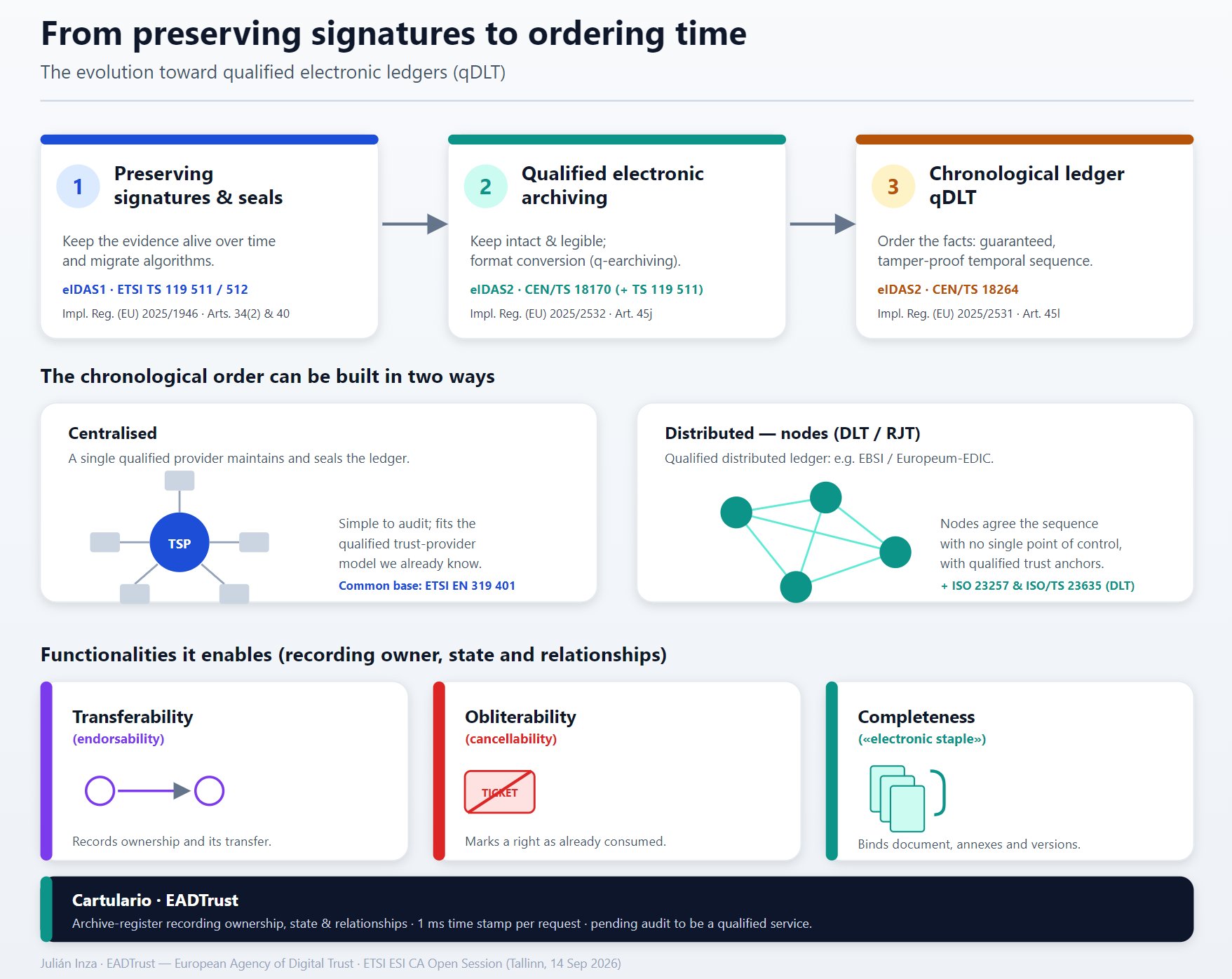
The first is to use a centralised infrastructure: a single qualified provider maintains the ledger, seals it and is accountable for its integrity. It is simple to audit and fits perfectly into the qualified-provider model we already know.
The second is to use an infrastructure of interconnected nodes that replicate the information (sometimes called a distributed infrastructure): the chronological order is built through the connection of nodes that agree among themselves (through governance rules) on the sequence of entries. This is where distributed ledger technology (DLT) comes into play — not as a fashion, but as a concrete way of achieving that ordering without depending on a single point. When that distributed ledger is provided with the guarantees of a qualified trust service, we speak of qDLT: a qualified distributed ledger.
Allow me a terminological note here that I have been making for some time. The Regulation has enshrined the term DLT (Distributed Ledger Technology), and I stick to it for regulatory rigour. But, if we were to name the idea precisely, I would rather speak of RJT (Replicated Journal Technology). The reason is accounting: in double-entry bookkeeping, the chronological order of events is not kept in the ledger (the general ledger, which groups entries by account) but in the journal (the day book, which records them one after another as they happen). And since what we are preserving here is precisely the temporal sequence, the fitting name for this technology should point to the replicated journal rather than to the distributed ledger. It is, most likely, a terminological battle already lost against the official text, but no less accurate for that.
A good European example of this approach is EBSI, the European Blockchain Services Infrastructure, today governed through the figure of the Europeum-EDIC (a European digital-infrastructure consortium). EBSI shows that the distributed model is not incompatible with qualified trust: the nodes can be operated by identified administrations and providers, with governmental trust anchors, so that the result combines the resilience of distribution with the legal accountability that the eIDAS framework demands.
And it is worth noting a detail of Commission Implementing Regulation (EU) 2025/2531, because it captures this duality precisely. The implementing act requires all providers of qualified electronic ledgers to comply with the standard ETSI EN 319 401 (general policy requirements for trust service providers) and adds specific requirements for the distributed variant: when the ledger is built through nodes, the provider must also comply with ISO 23257:2022 (reference architecture for distributed ledger technologies) and ISO/TS 23635:2022 (governance guidelines). In other words, it is the implementing act itself that recognises the two variants and reserves the DLT consensus and governance standards for the distributed case, which is when we speak, properly, of qDLT. Regulation, once again, does not impose a technology: it describes guarantees and leaves the way of achieving them open.
It is worth underlining the regulatory continuity: from preservation (511) we move to qualified archiving (18170), and from there to chronological ledger, or qDLT (18264). These are not three worlds but three layers of a single idea that keeps gaining ambition: first, keeping an electronic signature fully effective; then, holding a document (signed or not) while guaranteeing its future recovery; and finally, ordering and relating the facts in a verifiable way, when that order can produce legal effects.
What a chronological ledger makes possible
The part I find most interesting (and to which I devoted much of my intervention) is not the ledger technology itself, but the functionalities it enables when we register not only the document but also its context: who its owner is, what rights it embodies and how it evolves. A well-designed chronological ledger opens the door to three capabilities that until now were hard to bring into the digital world with full guarantees.
The first is transferability (or endorsability). If the ledger records not only that a document exists, but also who its holder is, then it can equally record the transfer of that ownership. This is what allows an electronic file to be treated as an asset that changes hands: think of commercial paper, of documents of title to goods, or of any right that was traditionally «endorsed» on paper. The chronological ledger turns the chain of endorsements into a verifiable sequence of entries.
The second is obliterability (or cancellability). A right is not only transferred: it is also consumed. If a file represents a cinema ticket or admission to a show, we need to be able to mark that the right has already been exercised, so that it cannot be used twice. The ledger does not delete the entry (the evidence remains) but records indelibly its change of state: issued, transferred, consumed. It is the difference between crossing out and throwing away: the fact that a right has been exhausted is, in itself, a fact worth recording. The postmark is a good example.
The third is completeness, which I like to describe as an electronic staple. A document rarely travels alone. A contract carries annexes; a deed carries endorsements; an agreement evolves through successive versions. Think of contractual novations, in which the parties agree to modify the clauses: what matters legally is not only the latest text, but the complete relationship between the original document, its annexes and each of its evolutions. Completeness consists of keeping the document and everything that accompanies it (notes, annexes and their own versions) verifiably bound together, so that the whole is preserved as an indivisible and traceable unit. The staple does not just hold papers together: it records the order in which they were joined.
These three functionalities share one trait: they are only possible if the ledger stores more than the document. It stores its ownership, its state and its relationships. And they are only trustworthy if that information is ordered in time in a way that cannot be tampered with. That is why the qualified chronological ledger is not a technical whim, but the substrate on which one can build services that until now were tied to paper or to closed trusted intermediaries.
A database with legal ancestry: book-entry securities and EADTrust’s Cartulario
For these three functionalities to be more than a promise, one needs to manage a database associated with the service, with very specific properties: it must record, for each archived object, who its holder is, in what state the embodied right stands (and where or against whom that right is exercised) and how it relates to other documents; and it must do so in such a way that every change is recorded in sequence and is enforceable against third parties. Anyone familiar with securities law will recognise the pattern at once, because it is exactly the one governing the representation of securities through book entries («anotaciones en cuenta» in spanish): an accounting register in which ownership, transfers, encumbrances and the extinction of rights are not documented on a physical certificate but are constituted and proven by their inscription. Transferability is, in that language, the transfer of the entry; obliterability, its cancellation; completeness, the link between the principal entry and its ancillary ones. It is no coincidence: the qualified chronological ledger and the book-entry register solve the same problem (giving certainty about the ownership and state of a right over time) with the same tool: a reliable, ordered database.
At EADTrust we have been working on this idea for a long time. Our Cartulario service was designed many years ago on precisely those premises: treating the archive not as a mere repository of files, but as a register that records ownership, state and relationships, with an eye on functionalities such as endorsability, cancellability and completeness long before the European regulatory framework captured them explicitly.
And since we are on the subject of the name: Cartulario is simply the Spanish word for a cartulary (also spelled chartulary) — in the Middle Ages, the codex in which monasteries and cathedral chapters copied and safeguarded their charters, privileges and donations so they would not be lost (it is, roughly, the great-grandfather of the notarial protocol). So, all things considered, at EADTrust we have been in this business of chronological-order archiving for several centuries before the PDF was invented; the only difference is that we have swapped the vellum for a digital server and the copyist monk for a millisecond-precision time stamp.
And to that foundation Cartulario now adds a refinement that goes straight to the heart of what we were discussing in Tallinn: millisecond-precision (1 ms) time stamps associated with every archiving request. When the proof is the ordering, temporal resolution matters: having a millisecond-precision mark on each operation makes it possible to guarantee the chronological order of entries with far greater fineness, and to resolve the sequence unambiguously even when several requests pile up within a very short interval. It is, in practice, the materialisation of that idea of a «chronologically ordered archive» from which this whole line of reasoning starts.
Why this fits with the rest of the ecosystem
I do not want to close the article without connecting this story to the broader conversation about European digital identity. The ecosystem of the European wallet (EUDI Wallet) and of electronic attestations of attributes needs solid trust anchors: places where one can verifiably record who said what, about whom and when. A qualified chronological ledger (centralised or in the form of qDLT) is precisely one of those anchors. It can join the world of identity with the legal accountability of the eIDAS framework.
And all of this still rests on the first stone I mentioned at the beginning: the ability to preserve evidence over the long term and to migrate algorithms when needed. The arrival of post-quantum cryptography does not invalidate this architecture; on the contrary, it makes it more necessary. A ledger that orders documents in time must be, by design, a ledger capable of surviving the passage of time, including the time when today’s algorithms cease to protect us or the document-encoding formats are replaced by others.
That was, in essence, my thesis in Tallinn: that DLT and qDLT do not appear out of nowhere, but are the next natural rung on a ladder that began by preserving signatures, went on to archive documents, and is now learning to order facts. Seeing it this way helps a great deal not to get lost: each new standard does not replace the previous one, it adds a layer of ambition to it.
And here is my presentation summarising this article:
Try Cartulario
If you would like to experiment with these ideas on a real service, at EADTrust we make Cartulario available to anyone who wishes to try it. Its current nature is worth stating with full transparency: today it is offered as a non-qualified trust service and is pending audit to be considered a qualified service within the eIDAS framework. This distinction is no minor nuance (it is, precisely, the line that separates a trust service from a qualified trust service), and we prefer to make it clear from the outset.
Anyone who wishes to learn about it, propose a pilot project or discuss use cases (endorsability, cancellability, completeness or millisecond-precision time-stamping) can write to us at info@eadtrust.com or call us at +34 902 365 612 / +34 91 716 05 55. More information at www.eadtrust.eu.
 Todo es electrónico