Archivo de la categoría: Europa

FESA, the Forum of European Supervisory Authorities for Electronic Signatures


Aunque parece que el Foro FESA (Forum of European Supervisory Authorities for Electronic Signatures) está un poco inactivo últimamente, puede ser interesante rescatar alguno de los documentos que han publicado, orientados a resolver dudas sobre la aplicación de la Directiva 1999/93/CE.

FESA, the Forum of European Supervisory Authorities for Electronic Signatures, is a forum open to those bodies who are responsible for the operation of systems of supervision as they are defined in the European Signature Directive 1999/93/EC. The scope of FESA is to support cooperation among such bodies and to develop common points of view for the dialog with political or technical institutions.

FESA members meet regularly at least three times a year (not sure of this), exchange information and discuss matters of cooperation between supervisory authorities.

Statute

1. Scope

The scope of the Forum is to support cooperation among bodies responsible for the operation of systems of supervision as defined in Art. 3.3 of Directive 1999/93/EC*, harmonisation of such bodies’ activities, and to develop common points of view for the dialog with political or technical institutions, in particular the European Commission, the Electronic-Signature Committee referred to in Art. 9 of Directive 1999/93/EC, and standardisation institutions. It is not intended to duplicate the work of the Article 9 Committee.

The Forum is no legal entity. Performing their supervisory activities the members cannot be bound by decisions of the Forum.

2. Members

The following institutions are invited to become members of the Forum:

a) national bodies responsible for supervision according to Art. 3.3 of the Directive 1999/93/EC and/or for voluntary accreditation or approval schemes from all European Union and European Economic Area member states that have an interest in discussing the scope of the Forum (Art. 1),

b) comparable bodies from European Union candidate states, and

c) upon unanimous vote, comparable bodies from other countries that have transposed or intend to transpose the Directive 1999/93/EC.

Each member decides on its representatives in the Forum.

The Board keeps a directory of the members of the group. The simple majority of the members present at the assembly of the Forum decides in cases of doubt about membership.

3. Associate Members

National bodies responsible for supervision and/or voluntary accreditation or approval schemes with regard to products or services comparable to those within the scope of the Directive 1999/93/EC from countries that are not members of the EU or the EEA and are not EU-membership candidates, may apply for associate membership if they have an interest in discussing the matters within the scope of the Forum (Art. 1).

The applications may be granted by a unanimous vote of the members present at the assembly of the Forum.

The European Commission has the rights of an associate member.

Associate members may attend the assembly of the Forum and have similar rights to the members, except that they do not have the right to vote and can not be elected to the Board. Upon request of a member, the Board can decide that specific issues must be discussed only among members.

4. Guests

The Board can invite guests according to the agenda of a meeting.

5. Assembly of the Forum

The Forum meets regularly. The Board invites for the meeting of the assembly at least two times a year or if five members request it. Invitations must be sent at least one month in advance.

6. Decisions of the Forum

The Forum can decide using presence voting, if all members have been invited and the topics for decision have been included in the invitation. For decisions which require a unanimous vote, at least half of the members must be represented at the assembly. Only members that are represented at the assembly have the right to vote.

The Forum can also decide using the written voting procedure. The decision about the use of the written voting procedure is made by the Board and announced using electronic means. In this case, the proposal to be decided upon is distributed to the members by the Board along with the announcement. The Board also sets a deadline not shorter than 14 calendar days from the day of the announcement for voting. For decisions which require a unanimous vote, at least half of the members must cast their votes. Members may cast their votes using electronic means. Within five days after the deadline, the Board officially announces the result of the voting procedure and publishes the final text of the decision adopted, if any. During the deadline, any Forum member has the right to request the use of the presence voting procedure. In this case the written voting procedure is terminated without result and the issue is examined at the next meeting of the assembly.

Approval or modifications of this statute must be decided unanimously.

7. Board

The Board consists of a chairman and two secretaries. Each Board member must be a representative of a Forum member.

The Board is elected by the Forum. The three members of the Board are elected separately. The Forum decides whether the votes are given open or by ballot.

If a candidate does not get the simple majority of valid votes in the first vote, a second election decides among the two candidates with the most votes. If only one candidate is nominated, this candidate needs the simple majority of attending members.

The Board is elected for a period of two years beginning with the day of the election. Board members can resign at any time. A Board member loses its function, if it stops being a representative of a Forum member or if the Forum member leaves the Forum. When a Board member resigns or loses its function, a new Board member is elected for the rest of the period. At any time, the Forum can decide to elect a new Board (Art. 5).

In case it is not possible to elect a chairman until the end of a regular period, a temporary chairman for the period until the end of the next meeting may be elected by the Forum.

8. Duties of the Board

The Board shall

a) call the assembly of the Forum and prepare the meeting in cooperation with the hosting member,

b) decide on the agenda of these meetings and select persons for moderating the discussion,

c) invite guests to the meetings according to the agenda and the Forum’s statute,

d) take and distribute the minutes of the meetings.

The Board comes to its decisions unanimously and is represented by its Chairman.

Public documents

The following documents have been published by FESA:

DTCE – Digital Trust and Compliance Europe


Esta nueva asociación internacional trabajará para impulsar entre sus miembros, y con las administraciones públicas de toda Europa los principos de interoperabilidad que faciliten entre otros aspectos, el uso de la firma electrónica, sin trabas, de forma transfronteriza. Pretende constituirse en interlocutor idóneo con los reguladores europeos y nacionales en temas relacionados con la firma electrónica y la identificación digital.

Son candidatos a formar parte de la asociación prestadores de servicios de certificación y fabricantes de hardware criptográfico, pero también están representadas otras especialidades relacionadas con el objeto de la asociación.

Aquellas entidades interesadas en formar parte de la asociaciación deben contactar conmigo lo antes posible (julian punto inza arroba albalia punto com o julian punto inza arroba eadtrust punto net).

Public Consultation on Electronic identification, authentication and signatures


As always, the last day comes quickly without enough time to prepare a sound document.

But tomorrow is the last day for this consultation and I though that my opinion could help to others.

Public Consultation on Electronic identification, authentication and signatures

1. Respondent information

Are you replying: On behalf of an organisation
Please provide the name of your Organisation
EAD Trust, European Agency of Digital Trust
Please provide if applicable, your interest Representative Register ID number
Please indicate which type of stakeholder you are Small or medium-size enterprise
Please provide your Name and Surname
Julian Inza
Please provide your email address
julian@eadtrust.com
Your country of residence Spain

2. General expectations regarding EU legislation on e-signatures, e-identification and e-authentication

Question 1: Do you / Does your organisation use e-signatures, e-identification and e-authentication?

yes
If yes, what are your specific needs? Secure transactions
Unambiguous identification of contract partners
Integrity of electronic documents
Legal effect
Legal effect, contract signatures in particular
User convenience
Others
Please comment why
Electronic invoice, electronic documents of all kinds, electronic evidence

If yes, how frequently do you carry out secure transactions?

Daily

Question 2: For what online transactions do you consider electronic identification, authentication and signatures useful in coming years?

eGovernment services
Electronic Public Procurement
eCommerce transactions
eBusiness transactions
Online banking and financial transactions
Issuance of authentic electronic documents
Secure archiving or storage of authentic electronic documents
Others
Please comment why
electronic invoices, secure identification in social networks, electronic banking, web services, automated electronic seals,…

Question 3: What socio-economic benefits or drawbacks do you expect from the use of electronic signatures, identification, and authentication in other sectors of activity than yours?

A huge improvement in efficience and costs reductions. More security, more convenience, tele-operations of all kinds
Question 4: Would a stronger involvement of financial institutions in the provision of trusted e-signature and e-identification services have an impact on the take-up of e-signature and e-identification in other sectors? yes

If yes, what would be the appropriate incentives?

A simpler way to manage revocation information of certificates and to define trusted root certs and chain of trust&nbsp
Question 5: Do you think that there are specific interoperability or security aspects that should be taken into account to foster the use of electronic signatures, identification and authentication through mobile devices (e.g. requirements on the SIM cards, on the handset, on the mobile operator)? yes
If yes, regarding: operational
technical

Question 6: For which of the following trust building services and credentials should legal or regulatory measures be considered at EU-level in order to ensure their cross-border use and why?

Electronic seals
Time stamping
Long term archiving
Certified delivery of mail
Pseudonyms
Certified electronic documents in general
Others (please list)
Please list
Long term accesible digital custody /electronic chartulary /electronic headoffice /secure verification code / certification validation services

3. e-signatures tailored to face the challenges of the digital single market

Question 7: How do you judge the take-up of electronic signatures in Europe?

Very high
Please comment why
Citizen ID cards are being adopted in advanced countries, which include 2 or more certificates. Virtuous circle fosters the creation of adapted services
Question 8: Which of the following issues have a negative impact on the uptake of e-signature? You may select up to three answers that have according to you the most important impact. Lack of user-friendly signature solutions
Others
Please comment why
Poor solution for trust discovery of roots CA, bad implementations of OCSP in AIA extension of certificates, insufficient use of timestamping / not enough use of complete (AdES_XL) signatures, legacy management of CRLS to OCSP responses (bound to grace period), excesive use of CRLs for validation

Question 9: Which of the following specific issues have an impact on cross-border interoperability of e-signatures in Europe and should be addressed in a revised legal framework on e-signature (the references point to the articles and annexes of the eSignatures Directive)?

Unclear terminology in Directive 1999/93/EC and heterogeneous terminology in national legislations
Heterogeneous approach to security requirements (e.g. certification requirements on the signing software in some countries)
Insufficient harmonisation of profiles of qualified certificates
Other
Please comment why
Lack of clear definition of electronic seal for legal persons, lack of clear definition of codes to inform about power of attorney in certificate extensions, unclear effect of qualified certificates without secre signature creation devices, lack of clear definition of automated signature&nbsp

Question 10: Which among the following options could be solutions for signature verification and validation at EU level?

Other
Please comment why
Common list of OCSP services and timestamping services for all Trusted CAs in Europe. Signature software that creates always AdES-XL signatures including Timestamping and OCSP validation, getting the OCSP address from the AIA field of the certificate. OCSP services with grace period=0, supplied by the CA issuing certificates or a entity in its behalf, forbid the use of CRL for validation purposes. Relying party software that verifies XL signatures, Digital custody for secure storage of signatures,
Question 11: Do you have specific expectations from e-signature standardisation to cover? Mass signature (server signing)
Mobile signature creation devices
Remote signature
Others
Question 12: Do you use «qualified» e-signatures? yes
If yes, how often per month and for which kind and value of transactions?
3/4 per month. Transactions not connected to value. I believe transaction amount limits are relevant only to a few kinds of signatures.

Question 13: What is your view on the need to revise the security provisions of «qualified» e-signatures?

The current provisions should stay as they are

Question 14: Would a classification of a range of e-signatures be desirable to match different levels of security?

Yes, a classification would be convenient, it should be defined by law and a legal effect should be associated to each or some classes.
Please comment and explain for which usage a classification would be desirable.
legal person seal, automated signature, powers of attorney with use limits, SSL certificate with legal effects, sinonimous certificates and their effects, qualified certificates without SSCD. person associated to a company or government body acting in assigned role but not needing a representation letter or power
Question 15: Should «electronic consent» be recognised formally by future European legislation? yes

If yes, should legislation (where necessary supported by operational and technical standards) define specific requirements on:

Others
Please explain why
It is already recognized in standards and is named «content commitment». When a certificate has that bit activated, should verify a proof of consent, including a turing test demonstrating the user has read the message and asking clearly for consent. This kind of use should generate evidences for all involved parties and, where possible, an accesible digital custody (chartulary+electronic headoffice+secure verification code) receipt for them)
Question 16: Should «electronic consent» be considered as equivalent to electronic signatures? yes

Question 17: Are there specific aspects that should be taken into account to address electronic archiving?

yes
If yes, please specify the legal provisions which are needed in your opinion to address electronic archiving needs?
All electronic documents (signed or not) with legal effect, should be available under security considerations applied to archive (WORM), through a URL of trusted sites (electronc headoffice), with the help of a secure verification code. With additional measures for preserving privacy in specific cases, or to allow to be accessible to third parties for proof or evidential reasons. Paper documents or receipts withs URL and SVC, that can be verified against the electronis versions are considered trustworthy equivalent to authentic documents

4. Principles to guide e-identification and e-authentication in europe

Question 18: Do you see a need for additional legal or regulatory measures on electronic identification at EU-level? yes

If yes, in your opinion, what are the general principles that should underlie the legal provisions on the mutual recognition and acceptance of e-identification at EU-level?

Others
Please comment
compatibility&nbsp
Question 19: What effects for the digital single market do you expect from legal provisions on an EU-wide mutual recognition and acceptance of eID issued in the Member States? Legal certainty
Reduction of administrative burden
Other
Please comment why
Simplicity for citizen to exercise their rights in all countries, Convenience for citizens, efficience for government bodies and enterprises

Question 20: How could users provided with electronic identification and authentication means benefit from their mutual recognition and acceptance across Europe and in which sectors?

Increase of user convenience
Simplification of access to online services
Reduction of numerous UID/passwords
Reduced exposure to ID theft
Others
Please comment why
Use in day by day in non online services, to dematerialice paper

Question 21: What are the specific aspects that should be taken into account to achieve cross-sector interoperability of electronic identities?

Others
Please comment why
Common list of trusted CAs and their roots, Common profiles, common OIDs definitions, Correct codification of OCSP servers in AIA fields

Question 22: Please indicate experiences and lessons learned in the private sector that could be transferred to the public sector.

Please make everything EASY for the final user. And define a consistent user experience for all ID cards. Users then can detect if someone try to cheat them (identifying unusual use patterns)

5. Legislative measures for the challenges ahead

Question 23: What European Union legislative measures on e-signatures, e-authentication of natural and legal person claims as well as e-identification would be appropriate in your opinion to best meet the challenges of the digital single market?

Other
Please comment why
Reglament better than Directive. Clear rules. Clear language, Legal framework ligned with standards (standards are now better than law, but can not be used in the best way because law does not cover some technical uses)

6. Research and Innovation

Question 24: On what issues should EU R&D and standardisation focus to have all the necessary technology to improve eID management?

Nothing. A lot of money has been spent in past years without real improvement. We have standards. We should use them and in some cases improve them, with normal budget.

Question 25: On which technologies should Research & Development focus to improve the usability of e-signatures and electronic identification for end users and to facilitate the deployment for service providers?

Timestamping services, OCSP services, custodian services, registered notice services, mobile service, intelligent NFC services, interoperability services

Question 26: What technologies could contribute to overcoming the lack of trust in electronic identification, authentication and signatures in the European Single Market (ex. addressing the so-called «what you see is what you sign» issue)?

TSL, XAdES-XL, PAdES-LTV, writen signature digitalization with security measures binding the signature to the document in a way equivalent to «advance signature» with use of trusted third parties

7. Others

Question 27: Europe is fully part of the global economy. However, the forthcoming legal framework cannot cover non EU countries. Are there nevertheless international issues that should be taken into account?

The development of the legal framework must take into account existing standards or be compatible with future global standards. For instance RFC 3739

Question 28: Would you wish to share some best practices examples outside Europe?

Maybe connection of strong authentication with ID cards to federated identity systems (such as SAML) or simple authentication systems such as Open-ID can facilitate the use of Strong identity in social networks

Question 29: Are there any other issues which you think should be addressed by policy makers?

Yes. The use of ID systems and electronic signatures should be a strategic movement covering all kind of documents and sectors. In the past different lobbies or groups of interest have tried to convince EU policy makers to take out electronic signatures from electronic invoices to cite just one area. Electronic signatures should be used consistently in all areas or, at the end, exceptions will be greater that the rule and electronic signature can become useles or even worst, dangerous.
Meta Informations
Creation date
15-04-2011
Last update date
User name
null
Case Number
089674306510210511
Invitation Ref.
Status
N
Language
en

BackTrust in CeBIT


We at Albalia are trying to discover our international market. We are going to be at CeBIT with several appointments with potential partners. We already have been at CeBIT last year, with our own booth, in the framework of the spanish pavillion.

We now focus on our BackTrust product. A complete suite that allow to dematerialize all kind of documents, and manage electronic evidences. The core sistema manages electronic signatures and digital custody, and is suitable to deploy eGovernment solutions, and also ebanking, eHealth, eCommerce and eDocuments.

Our solutions helps manage electronic signatures (in the sense of Directive 1999/93/CE), and also digitalized signatures, biometric proofs and electronic evidences (such as certified digitization), thus allowing to eliminate paper while preserving evidential proof of the electronic registers.

Our BackTrust suite is available on zEnterprise with the name zBackTrust, and it is the only electronic signature solution in the world for IBM mainframes (both for Linux for System z, and z/OS). The solution is certified by IBM and is already deployed in customers as NovaCaixaGalicia (see page 12).

Others of our solutions are also mentioned internationally:

  • The Albalia team is very active in Social NetWorks (in Spanish):
  • BackTrust, electronic signature suite


    Spanish company Abalia has developed an Electronic Signature technology (Backtrust) as a system to different needs related with digital signature and digital custody of electronic documents. The system provides signature and validation tools in XML, CMS and PDF format available in different modules separately or as a whole pack. The obtained signatures include validation and time-stamping data in every format for a long term. The company is looking for commercial and licensing agreement.

    See Profile and link in the Technology market section of Enterprise Europe Network

    The Electronic Signature technology suite holds the following tools:

    • Batch Signer: A desktop tool that allows to sign several electronic documents in every batch. It supports versions to sign PDF and XML files such as electronic invoices (UBL, CII and other formats).
    • API: Integration tool for electronic signatures inclusion in the applications by developers. It supports versions for
      Microsoft .NET and Java.
    • WebSigner: Component of AdES basic electronic signature for Web sites.
    • BackTrust DSS Server: Electronic signature server based on OASIS DSS webservice standard.» PKI or Public Key Infrastructure servers: Certification authority, validation and timestamping authority.

    Innovative Aspects:

    The innovative Electronic Signature technology includes an integration API tool for electronic signatures in third party applications. Designed for software developers and integrators to help them to complete their applications with electronic signature services, its main key features are:

    • Microsoft .NET and Java standards availability.
    • Local signatures management through different keystores access. (i.e.: windows keystore, files in PKCS#12 format, HSM devices using PKCS#11 format).
    • It generates CMS, XMLDsig, PDF and XadES signature formats.
    • It generates complete signature format (XAdES-XL) by accessing to new company’s services.
    • Full integration with the other company developments and applications. Easy connection to other VA and TSA servers.
    • The system holds a specific version for electronic signatures in billing systems based on an invocing with security
      sytem format with specific signature policies compliance (XadES-EPES or XadES-XL).

    5th International PEPPOL conference: “eProcurement without borders – it’s time to connect!”


    As a major implementation of OASIS UBL-Universal Business Language (and the soon to be OASIS BusDox) electronic invoicing experts may be interested in attending or following the 5th International PEPPOL (Pan-European Public eProcurement On-Line) conference.

    The conference will take place from Monday 8th of November 2010 to Wednesday 10th of November 2010 in Troyes, Champagne, France.

    “eProcurement without borders – it’s time to connect!”

    More information, program and registration

    As the PEPPOL project has moved into its pilot phase this 5th Conference will be an occasion to inform the PEPPOL community about the latest achievements and planned activities. Following from previous events in Oslo, Copenhagen and Malmo, the conference in Troyes will be a unique opportunity to hear from and meet with over 300 key players in the areas of eGovernment and eProcurement.

    The meeting will also provide plenty of opportunities to exchange  information, opinions and ideas with over 300 key European players in  the areas of eGovernment and eProcurement.

    The Opening  Plenary will take place in the Espace Argence with opening  addresses followed by a plenary roundtable discussion. A famous  Champagne winery will be the location of the gala dinner.

    The  second day will be hosted with a  series of parallel sessions. The day will conclud with an exhibition and  will provide opportunities for networking.

    The third day focuses on  business solutions and a series of working sessions for special interest  and standardization groups. In addition, a social programme will be  proposed by the City of Troyes for accompanying partners.

    6th European EXPP Summit


    Hilton Munich Park Hotel, Munich, Germany
    October 11 & 12, 2010

    Europe’s leading Congress on E-Invoicing & E-Billing will celebrate its sixth anniversary this year.

    More than 350 E-Invoicing experts and interested parties from about 30 countries will meet in Munich to exchange views about current trends and perspectives.

    Top-notch speakers will talk about their experiences with E-Invoicing projects over the course of two days. The European EXPP Summit 2010 will reward the participants with an exclusive series of success stories and best practice sessions from numerous industries across Europe.

    • Hear the latest news on market trends, perspectives, standards and initiatives
    • Success stories telling how the Procure-to-Pay process and the Financial Supply Chain have been improved and how they can help to reduce costs considerably
    • Focus on the different possibilities for implementing E-Invoicing & E-Billing and for harmonising legislation in Europe

    The mixture of lectures from experts in the field and professionals with practical experience, as well as podium discussions, roundtables, large exhibition area and especially the focus on Europe will make the European EXPP Summit 2010 a compulsory event for CEOs, CFOs, CIOs, Heads of A/R and A/P, Procurement, Invoice Management and E-Invoicing decision makers from all over Europe.

    Further information and the registration form can be found at: www.expp-summit.com

    Offinvoice, the free eInvoicing solution for everybody


    In 2009 Albalia worked for Microsoft creating FactOffice, the first free and open source solution to manage electronic invoices. The solution managed OOXML files in which spanish facturae XML format could be inserted and extracted, allowing that any unmodified Word 2007 processor could visualize and print electronic invoices.

    facturae XML format includes a tiny definition on how a XAdES-XL signature can be included in the invoice. This specific kind of  XML Advanced Electronic Signature (defined in the standard TS 101 903) has the advantage that, when created by the signing party, releases the receiving party from the obligation to further check validity of the included certificate, since OCSP response and Timestamping is already included.

    FactOffice solution set up was very easy and created a new menu «facturae» in Word 2007, allowing several functions regarding creating, signing, sending and receiving electronic invoices.

    This solution has been awarded by Catcert as the best private sector solution to foster electronic signature, including a «top class» electronic signature manager.

    In 2010 Albalia worked for Microsoft creating Offinvoice, the first free and open source solution to manage electronic invoices in CII (Cross Industry Invoice) XML format. By the way, Offinvoice is a big enhacement  from FactOffice, since it is able to be installed in both Word 2010 and Excel 2010, and manages facturae 3.2 XML format, and UBL in addition to CII. This is specially significant if you consider that Office 2010 has justbeen released (we were working with beta VSTO development tools) and there is not yet an implementation of CII (by the way, we could not find any CII development tools, and worked with the bare schema definition 1.0).

    For the electronic signature part of the invoice, we have been working with early versions of the UBL recommendations around ETSI TS 101 903, that takes into account the needs of messagges such as order or invoice. We have adhered to XAdES-XL kind of signature for the same reason this was the preferred method in Spain: to release the receiving party of any complex process regarding electronic signature, without adding complexity to the issuing party. Since XAdES-T is included as part of XAdES_XL, the selected method grants compliance to the users of those countries in which that kind of signature is mandatory (by the way, XAdES-XL includes in onion layers: XAdES-BES, XAdES-T, XAdES-C, XAdES-X and, of course, XAdES-X-L).

    We really believe (and also some Microsoft guys that have been working with us and helping us a lot) that this software can be a «killer application» for SME all over Europe, because it makes easy both sending and receiving electronic invoices, creating and verifying electronic signatures and converting among different XML formats.

    At this moment, Offinvoice is available in 3 languages: english, spanish and catalan. We are looking for colleages in other countries that can help us to translate Offinvoice to all EU languages. If you are interested, please contact with joaquin (dot) lopez (at) albalia (dot) com and tell us the language that you would like to translate to. We will send you the english version of the language files to manage, whith instructions on how to do the job. Thank you in advance.

    We are also looking for new sponsors that can help us to include  additional features in Offinvoice.

    Albalia has created a special electronic signature library for Offinvoice (B4O: BackOffice for Offinvoice), which is not open source, but is free if used in connection to Offinvoice. This is the License

    Related information

    V Congreso de Factura Electrónica y Digitalización Certificada de ASIMELEC


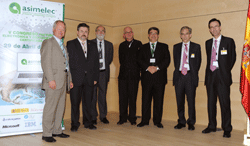
    Aunque con algo de retraso y tras la publicación de otros resúmenes, como el de Bartolomé Borrego, que uso como referencia, incluyo seguidamente mi resumen del evento que el 29 de Abril del 2010 tuvo lugar en el Auditorio de la Secretaría de Estado de Telecomunicaciones y para la Sociedad de la Información, del Ministerio de Industria, Turismo y Comercio.

    El  V Congreso de Facturación Electrónica y Digitalización Certificada convocado por ASIMELEC se celebró a continuación de la reunión de alto nivel de factura electrónica, organizado por la Comisión Europea, con apoyo del MITyC los dias 27 y 28 de abril de 2010. Estos actos se inscriben en el marco de la presidencia española de la Union Europea en el primer semestre de 2010.

    La apertura institucional del Congreso corrió a cargo de D. Martín Pérez Sánchez, Presidente de ASIMELEC que resumió los logros de los últimos años en el impulso de la factura electrónica gracias a la participación del sector privado con el apoyo de la Agencia Tributaria y el Ministerio de Industria, Turismo y Comercio, con elevadas inversiones que se pueden perder si el Ministerio de Economía y Hacienda sigue incumpliendo los plazos indicados en la Ley 30/2007 y en la Ley 56/2007, en relación con la publicación de la normativa pendiente que completa la necesaria para facturar a las administraciones públicas, por lo que reclamó la máxima diligencia del citado Ministerio para resolver la situación. Agradeció al MITYC y al Ministerio de Presidencia el apoyo en las iniciativas de impulso de la Factura electrónica e introdujo a D. Fernando de Pablo, Director General para la Administración Electrónica del Ministerio de la  Presidencia, que anunció el compromiso de su departamento de constituir un “hub” -plataforma unificada- que aglutine en uno solo todos los sistemas que conviven en los distintos ministerios, lo que conllevará a un ahorro de costes importante. Fernando comentó la publicación en el CTT (Centro de Transferencia de Tecnología) de los documentos del grupo de trabajo de factura electrónica de las administraciones públicas.

    La primera ponencia del programa regular fue la de D. Gonzalo Die Socias, Director de Planificación y Relaciones Externas de  Red.es, quien habló del Impulso para la Adopción de la Factura electrónica por parte de la Administración, centrándose en los ejes del plan de promoción de la eFactura que está dotado con un presupuesto de 475.000 € y que abarca tres frentes:

    1. Un primer eje del tipo B2C, que persigue penetrar la utilización de la efactura en un 6%, y que va fundamentalmente destinado a la emisión de facturas.
    2. Un segundo eje consistente en el fomento del uso entre empresas y entidades locales, focalizado en el entorno B2B, y
    3. Un tercer eje dedicado a la creación de contenidos, en concreto, la creación de un Portal con contenidos que aporten empresas especializadas y entidades.

    En su ponencia se anunció una nueva edición (la 3ª) del ya tradicional libro sobre “La Factura Electrónica”, editado por ASIMELEC y Red.es  del que en breve se anunciará su descarga libre por  Internet.

    Yo presenté InvoiceX, un proyecto en el que participan nueve entidades: Albalia Interactiva, Asimelec, Atos Origin, Camerfirma, Desarrollo y Recursos, Eurobits, Invinet, Pimec y Seres y que está abierto a todas las plataformas de Facturación electrónica que operan en España. El proyecto esta apoyado por el Ministerio de Industria, Turismo y Comercio en el Plan Avanza2 con el código TSI-020512-2009-69. Se han incorporado al proyecto instituciones y entidades tales como Adquira, AECOC, Agencia del Conocimiento y la Tecnología de la Rioja, AOC, BBVA, Caixa Galicia, Docontime, Edicom, EJIE, GVA, Indra, Mityc y Telefónica.

    D. Víctor Usobiaga, responsable Financial Service Sector en IBM SPGI INDUSTRY BUSINESS DEVELOPMENT TEAM IBDT y D. Carlos Jerez, Director General de Notarnet, hablaron sobre las tres columnas en las que se sustentan los documentos electrónicos: gestión del documento, firma electrónica y custodia digital. Ejemplificaron el modelo con el caso de la digitalización certificada y finalizaron con una demostración práctica de cómo se digitaliza un documento con la solución DigiFactIn. También explicaron el potencial de la firma digitalizada si se emplea con las adecuadas medidas de seguridad.

    Tras el Coffee-Break, tuvo lugar una Mesa Redonda bajo el título “Challenges in the development of Electronic Invoicing in Europe”, en la que intervinieron D. Christiaan van der Valk, Chief Executive Officer de TrustWeaver, Mr. Bruno Koch, Chairman of the EXPP Summit, CEO en Billentis, Mr. Tony Nisbett, IBM eInvoicing SME – consultant to world-wide customer and supplier boarding teams de IBM, Mr. Olaf Schrader, Senior Production Manager for Supplier Enablement de Ariba Inc y D. Arturo González Mc Dowell, Director General de Eurobits.

    En la mesa redonda se analizaron aspectos como la necesidad de reglas de juego homogéneas y estables en toda Europa, para no desanimar a los innovadores, se reivindicó el uso de la firma electrónica como el modelo más efectivo de garantizar la autenticidad e integridad de las facturas electrónicas. Se barajaron algunas cifras, como que en Europa existen más de 140 plataformas de factura electrónica, que el  precio de emitir una factura en Finlandia (sin firma electrónica) es 5 veces más caro que en España (con firma electrónica) o que se han recopilado más de 240 preguntas prácticas a las diferentes administraciones tributarias de toda la unión europea sobre aspectos de gestión de facturas electrónicas, de las que solo 3 se refieren a la firma electrónica. Desde el punto de vista de Ariba, operador de factura electrónica multinacional, no importa cual pueda ser la complejidad de los requisitos, con tal de que sean los mismos en toda Europa, lo cual no parece que pueda lograse con la modificación propuesta de la Directiva 2006/112.

    Tras la mesa redonda, D. Arturo González Mac Dowell, tuvo una presentación independiente  sobre Iniciativas de Interoperabilidad, haciendo una analogía entre los sistemas de factura electrónica y los de  telefonía móvil.

    Alabó la iniciativa de la AGE, al definir la arquitectura de la factura a efectos de normalización de la factura electrónica.

    Por su parte, D. Ricardo Carballo Gestal, Director del Area de Excelencia Operacional de  Caixa Galicia, flanqueado por Alvaro González (Product manager de zBackTrust en Albalia), habló del entorno Mainframe de la Caja de Ahorros gallega, y de las razones que llevaron a la institución a seleccionar la aplicación zBackTrust de firma electrónica que se utiliza en entornos z/OS y zLinux. La estrategia de costes de IBM en entornos zLinux, la disponibilidad de hardware criptográfico IBM 4764 y 4765 ya instalado en los equipos y utilizados, por ejemplo, en el marco de la adaptación a SEPA y a EMV y la infraestructura de alta disponibilidad que permite alta escalabilidad, alta disponibilidad  y recuperaciones sin latencia en los centros de sistemas de la caja separados 2 kilómetros. Además la seguridad de los sistemas ha merecido la certificación Common Criteria EAL5, una de las más altas disponibles. El entorno resultante, uno de los más potentes destinados a la firma electrónica se está utilizando en el sistema de factura electrónica de la caja, pero también como sistema de validación para los cajeros electrónicos de la entidad que aceptan el DNI electrónico, de forma que no necesitan acceder a internet para conocer el estado de revocación de los certificados del DNI. Caixa Galicia ya impone a todos su proveedores tecnológicos la facturación electrónica en formato facturae, de modo que no es posible ser proveedor de las áreas tecnológicas de la Caja si no se factura electrónicamente.

    D. Santiago Segarra Tormo, Jefe de la Dependencia de Asistencia y Servicios Tributarios de la Delegación Central de Grandes Contribuyentes de la Agencia Estatal Tributaria, nos habló del resultado del proceso de reforma de la Directiva 112/2006 en la Comisión Europea.

    La nueva Directiva sobre Facturación electrónica recogerá diferentes medios para demostrar  la autenticidad e integridad de una factura electrónica:

    • Por una parte, sigue contemplando la posibilidad de utilizar la firma electrónica y EDI como sistemas válidos de facturación, opciones que ya se contemplaban en la anterior Directiva.
    • Por otra, introduce como novedad la posibilidad de utilizar otros sistemas tecnológicos distintos de los anteriores, como podrían ser: otros tipos de firma electrónica, de EDI, de archivo seguro, intranet, terceras partes de confianza, etc.

    Desde un punto de vista tributario, si se utilizan sistemas basados en la firma electrónica avanzada, el control fiscal será más fácil. Si bien, en el supuesto de utilizar otros procesos de negocio, aunque a priori parezca más fácil su utilización, resultará más difícil de demostrar que se generan las evidencias adecuadas a un proceso de gestión contable adecuado cuando se llegue al momento de la inspección fiscal. Esta mayor dificultad se aplicará tanto a las facturas electrónicas como en papel, por lo que, a la larga, los sistemas electrónicos con EDI o firma electrónica serán más sencillos.

    En el marco de los sistemas de gestión de autenticidad e integridad, decribió la posibilidad de introducir un CSV (Código Seguro de Verificación) como el que contempla la Ley 11/2007 que permita acceder a la web del emisor de la factura y cotejarla con la original. Esta posibilidad ya se recoge en la norma española EHA/962/2007.

    La principal novedad, por tanto se centraría en las evidencias de los nuevos procesos de negocio que se podrían calificar como pistas de auditoría fiables. Aunque con una aparente simplicidad, hablaríamos de sistemas en los que no vale todo: han de ser sistemas que puedan acreditar la autoría de una factura y su integridad, aplicando una triple conciliación (pedido, albarán, factura) y con validación semántica plena. Esto significa que las auditorías pueden ser más intrusivas.

    De acuerdo con esta nueva Directiva (art. 247), cabe por tanto el almacenamiento en papel pero también en soporte electrónico mediante la utilización del sistema de digitalización certificada.

    A continuación D. Héctor Sánchez Montenegro, de Microsoft, tras un breve repaso a las tecnologías disponibles y en particular a las más prometedoras de “computación en la nube”, hizo una introducción a la siguiente ponencia, que corrió a cargo de D. Santi Casas, socio-Director de ALBALIA INTERACTIVA, quien habló de OffInvoice, la solución internacional de facturación electrónica en entornos Office 2010.

    Héctor comentó iniciativas de Microsoft concurrentes con las de impulso de la factura electrónica, en particular en el ámbito del DNI electrónico y destacó una reciente prueba de concepto de “Logon” de Windows Live con el DNI electrónico.

    Santi Casas  hizo un recorrido histórico de las distintas aplicaciones y sistemas operativos que hemos venido utilizando desde hace 40 años hasta llegar al año 2009 en que se lanzó FactOffice y llegando a OffInvoice en 2010, aunque también adelantó algo acerca de Windows Azure Platform prevista para 2011, que será un sistema operativo totalmente en red pensado para el Cloud Computing.

    Comentó que a fecha de hoy ha habido más de 6.000 descargas de FactOffice  en Codeplex y que Offinvoice, diseñado para entornos Office 2010, permite trabajar tanto en Word como en Excel. Esta nueva aplicación da soporte a mútiples idiomas de la Unión Europea ya diferentes formatos de facturas: facturae, UBL y UN/CEFACT CII. FactOffice recibió en 2009 un premio de CatCert como mejor solución de firma electrónica, y Offinvoice incluye la misma tecnología de firma.

    Santi avanzó que la próxima versión de Office 2010 incluirá librerías propias XAdES de firma electrónica para las aplicaciones que se basan en el formato OOXML.

    Tras destacar las principales características de Offinvoice llevó a cabo una demostración de creación de una factura electrónica en Excel y su transformación a los diferentes formatos: facturae 3.1 y 3.2, UBL, CII o en papel, las cuales firmó electrónicamente con una tarjeta de Firmaprofesional. Un aspecto interesante de Offinvoice es que mantiene la estructura interna de las facturas (facturae, UBL o CII) dentro de ficheros OOXML como docx o xlsx, de forma que pueden visualizarse con cualquier aplicación compatible con OOXML (ISO 29500) aunque nos esté adaptada de forma expresa a la gestión de facturas.

    Sobre Innovación empresarial, más allá de la regulación y de la evolución de estándares habló D. Mario Tanco, Director General de Desarrollo y Recursos con una ponencia muy práctica y racional respecto de la problemática asociada a la facturación electrónica y la innovación. Destacó la importancia del uso de la información estructurada y desmontó algunos mitos sobre lso “problemas” de la facturación electrónica. Estuvo algo crítico con algunas instancias de la AGE, reconociendo el esfuerzo de otras, especialmente del MITyC.

    Tras el lunch, D. Oriol Bausa, Director General de Invinet Sistemes acometió su ponencia sobre ”Cross border invoicing”, señalando la importancia de los consensos en los estándares e identificando diferentes niveles de consenso: sintaxis, semántica, léxica y pragmática (de contexto). Repasó brevemente los perfiles definidos en CEN BII (CEN Workshop on ‘Business Interoperability Interfaces on public procurement in Europe’) que permiten definir un mínimo común (“core”) y extensiones nacionales, sectoriales y bilaterales. En los trabajos de CEN BII se utilizan los resultados de la Dirección General de Patrimonio  de España en torno al modelo ontológico de Códice (Componentes y Documentos Interoperables para la Contratación Electrónica). También trató sobre PEPPOL (Pan-European Public eProcurement On-Line), señalando que en este importante proyecto internacional no hay participación española.

    Mr. Tim McGrath, Co-Chair of the Universal Business Language (UBL) Technical Committee, de OASIS, que trató sobre OASIS – UBL as a first generation UN/CEFACT – CII. Tim valoró la jornada como “Top Class”, un elogio que alcanza mayor significación si se considera que el Congreso de ASIMELEC se ha celebrado a continuación de la Conferencia de Alta Nivel sobre Factura Electrónica organizado por la Comisión Europea y que tuvo lugar los dos días que precedieron al congreso, con amplia representación de de ponentes internacionales. Tim McGrath, además de su rolo como voluntario en el desarrollo de UBL, es Managing Director y Principal Consultant of Document Engineering Services , y Asisstant Technical Director del Proyecto Peppol.  Tim explicó la historia de UBL, y de la colaboración entre UN/CEFACT y OASIS, concretada en la aprobación conjunta de ebXML y de los CCTS (Core Component Technical Specification ) que suponen la metodología de construcción semántica de documentos. En base a los CCTS de UN/CEFACT, OASIS ha elaborado 60 documentos en la versión 2.1 de UBL, cubriendo toda la cadena de suministro incluyendo los datos necesarios para el comercio internacional y alineados con la Core Component Library (CCL) 08B de UN/CEFACT. Dado que la recomendación del Grupo de Expertos se ciñe a la semántica de CII (Cross Industry Invoice), merced al acuerdo entre OASIS y UN/CEFACT, UBL (que utiliza la misma semántica y ofrece un modelo más maduro y una sintaxis más definida) se configura como el modelo de implementación inicial de CII, mientras el estándar concluye su definición. Este enfoque se sigue ya en diferentes proyectos: OIOUBL, svefaktura, NES, ePRIOR, CODICE, Peppol, y BII.

    D. José María Sobrino, de la Subdirector General de Aplicaciones de Contabilidad y Control, de la Intervención General de la Administración del Estado (IGAE), del Ministerio de Economia y Hacienda, habló de Arquitectura Normalizada de Recepción de Facturas Electrónicas en la AGE (CTT) y de las conclusiones del Grupo de Trabajo creado para definirla. En el grupo de trabajo participaron 9 ministerios y 7 entidades públicas, con 23 personas de promedio en cada reunión. La comisión se estructuró en ponencias y el 25 de noviembre de 2009 se aprobaron las conclusiones: la propuesta de arquitectura, con la posibilidad de contar con un punto general de entrada de facturas electrónicas, la propuesta de interfaces normalizados y sus definiciones WSDL, la publicación de las conclusiones en el centro de Transferencias de Tecnología  (CTT) del Ministerio de Presidencia, lo que se hizo el 23 de diciembre de 2009, y la constitución de un comité de coordinación y supervisión integrado por representantes del Ministerio de la presidencia (coordinador) y de los ministerios de Economía y Hacienda; Industria, Turismo y Comercio; la Agencia Estatal de administración Tributaria y la Seguridad Social.

    Los formatos se basan en los definidos en la Orden PRE/2971/2007, dando soporte a facturae versiones 3.0, 3.1 y 3.2; firma XAdES EPES y XL; y política de firma facturae 3.1. Los accesos podrán llevarse a cabo con usuario/contraseña y mediante certificados y no se admiten lotes de facturas. Las facturas se pueden enviar, anular y consultar. Al hacerlo, es posible acceder por identificador de factura o apunte registral. El registro electrónico centralizado o del órgano de la AGE es uno de los puntos clave, y otro las interfaces entre las plataformas y los sistemas de gestión de los organismos. Las facturas se pueden gestionar de forma manual y de forma automatizada.

    Un gran trabajo de la administración pública que está a disposición de las plataformas de facturación electrónica para facilitar a sus clientes la gestión de facturas con la administración pública.

    La última ponencia del Congreso corrió a cargo de D. Anders Grangård, director de GS1  eCom Business Unit, y Co-Chairman de CEN eInvoice 3 que sustituyó a Stefan Engel-Fleschig, que no pudo quedarse por problemas de horarios de vuelo.

    Anders explicó las sucesivas fases que ha tenido el CEN Workshop on electronic invoice, eInv, que en estos momentos inicia su tercera fase, con una reunión que había tenido lugar, precisamente en Madrid, los días 28 y 29 de abril (la segunda tras el kick-off inicial). A lo largo de las sucesivas fases, se han publicado recomendaciones como los CWA 15575, CWA 15577 o CWA 15579. En la fase 2 participaron 70 compañías y 6 autoridades fiscales, y se tuvieron 10 reuniones plenarias, 2 conferencias públicas con más de 120 personas y se definieron 25 gestores de información de país, para la plataforma eInvoice Gateway. El Grupo de Trabajo de CEN cooperó con otros, como UN/CEFACT, ETSI, GS1, Odette o el Expert gropup.

    En la fase 3, que ha reunido a 30 personas en Madrid, se está trabajando sobre un juego de herramientas de verificación de cumplimiento que incluye al menos Reino Unido, Alemania, España, Italia, Francia, Polonia,… Va a ser posible desarrollar entornos de autocomprobación  respecto a un juego de criterios de conformidad.

    Anders agradeció a ASIMELEC y al MITyC el apoyo al CEN al facilitar los medios de reunión y el soporte logístico para los participantes y le deseó éxito en sus actividades.

    Tras ésta última ponencia tuvo lugar el Coloquio final con las Conclusiones que tuve el placer de resumir, y tras ellas, D. José Pérez, Director General de ASIMELEC cerró el acto con la correspondiente Clausura institucional, agradeciendo a los asistentes su participacion en una semana tan densa destinada a la factura electronica, con Madrid como sede protagonista.

    Otras referencias:
    Electronic Invoice Summit – Madrid – The 27, 28 and 29 of April 2010


    In the framework of events of the  Spanish Presidency of the Council of the European Union, will take place in Madrid the Conference on “Electronic invoicing in Europe” organised by the European Commission. This international Conference will gather european eInvoice experts in the Auditorium of the State Secretariat of Telecommunications and the Information Society in Madrid the 27 and 28 of April 2010. ASIMELEC Congress on electronic invoice (this year in its 5th edition) will take place on the following day, the 29th of April of 2010, so delegates can particiate on both events if they wish to.

    Aim of the conference

    Electronic invoices, compared to paper invoices, offer substantial advantages for public and private organisations of all sizes. Widespread uptake of electronic invoicing could be of considerable benefit for the EU economy with potential savings for trading partners (senders and receivers of invoices). However, most of the potential offered by e-Invoicing remains untapped, especially among SMEs, because of the continued existence of regulatory and technical barriers to its full deployment.

    Over the past few years, the European Commission has given continuous support to the uptake of e-Invoicing solutions. Several initiatives at European level have been launched in order to facilitate the emergence of a pan-European e-invoicing environment for businesses and public authorities. In particular, the Commission set up an independent Expert Group on e-Invoicing who proposed, at the end of 2009, a European e-Invoicing Framework (EEIF) with recommendations for the provision of e-Invoicing services in an open, competitive and interoperable manner across Europe.

    In parallel to these initiatives, other activities affecting the uptake of electronic invoices are:

    • The creation of the Single Euro Payments Area (SEPA) and
    • The VAT directive (2006/112/EC) and its proposed amendments on electronic invoicing currently discussed at the Council.

    The European e-Invoicing framework proposed by the Expert Group challenged the identified regulatory and technical barriers with recommendations addressing standards, interoperability, legal requirements and the uptake of e-invoicing by SMEs. These propositions have been published and are open to public consultation until the 26 February 2010.

    The conference is being held at an appropriate moment to debate the recommendations of the Expert Group and discuss the key actions to be taken to remove the barriers which currently affect the use of electronic invoices. In that respect, four sessions addressing the current difficulties of e-Invoicing are planned on :

    • SMEs and E-invoicing
    • Interoperability
    • Standards
    • Legal framework for electronic invoices

    Speakers will include Members of the European Parliament and the European Commission, representatives from the European Central Bank, high-level representatives of EU Member State governments, businesses, standardisation bodies and NGOs.

    The conference is organised by the European Commission under the auspices of the Spanish Presidency of the Council. The conference will take place at the State Secretariat of Telecommunications and the Information Society in Madrid the 27 and 28 of April 2010.

    This is a clear oportunity to learn more about UBL, the preferred XML format to be used internationally to foster electronic invoice interoperability.

    ASIMELEC eInvoice Congress

    ASIMELEC has been organizing  4 Congreses on Electronic Signature and Certified Imaging, and 2010 will see the 5th edition.   This year the event will show an international agenda with key bullets, such as interoperability issues, the ammendment of the VAT directive and fostering eInvoice adoption by SMBs. The date for the event is the 29 of april 2010, and will be organized in close relationship with the Official event.

    One of the succes case will be based on the  Invoicex Project.

    This V Congreso de Factura Electrónica y Digitalización Certificada, (5th Congress on Electronic Invoice and Certified Imaging) will have an approximate cost of 250 euros. In a few days, registration will be available at  ASIMELEC web site.

    Related articles: