Seminario de Diplomática Digital


La diplomática es una ciencia auxiliar de la historia que se ocupa de la autenticidad de los documentos, y que se definió inicialmente en 1681 a partir de la obra fundacional “De re diplomática” del benedictino Jean Mabillon.

En el ámbito de las Administraciones Públicas ha dado lugar al concepto de “diplomática contemporánea” que se ha uniformizado gracias a la Ley 30/1992.

Con la Ley 11/2007 se les da un nuevo impulso a los aspectos digitales de la diplomática, pero quienes tienen que implantarlos se encuentran frecuentemente con que no tienen el bagaje conceptual que permita resolver las dudas de aplicación más allá de la letra de la ley.

En el sector privado, la LSSI y el artículo 2 de la Ley 56/2007 marcan una orientación en la Gestión Electrónica de Documentos, pero hay dudas sobre el valor jurídico de muchas de las iniciativas destinadas a mejorar la eficiencia en la Gestión de Documentos. Cuando los proyectos de desmaterialización documental se acometen, se experimentan ahorros de decenas de millones de euros (en función de la dimensión de los proyectos), y períodos de recuperación de la inversión de entre 9 y 12 meses.

Atenea Interactiva organiza el próximo 24 de marzo de 2010 en el Hotel Nuevo Madrid el Seminario «Diplomática Digital«, en el que se desarrollan los conceptos claves para manejar documentos electrónicos auténticos, de la mano de expertos en Gestión Documental Electrónica de carácter probatorio, y se contextualizan en el marco jurídico español, aunque las ideas claves sean de aplicación universal.

El coste del evento es de 350 € + IVA (18%). Total 413 € por asistente. Este es el formulario de inscripción. Y este es el programa:

CONCEPTOS DE DIPLOMÁTICA

  • Archivística, Paleografía, Sigilografía.
  • Cartularios, Códices Diplomáticos, Tumbos, Becerros
  • Autenticidad de los documentos en papel
  • Partes de un documento
  • Tipos de documentos

MARCO LEGAL

  • Normativa en relación con los archivos
  • Normativa en relación con la Firma Electrónica
  • Normativa de Administración Electrónica
  • Normativa sobre Contratación Electrónica
  • Estándares aplicables en la Gestión de Documentos Electrónicos

DIPLOMÁTICA DIGITAL

  • Autenticidad de los Documentos Electrónicos. Obliterabilidad, Endosabilidad, Completitud
  • Firma Electrónica. Firma Avanzada. Firma Completa
  • Custodia Digital. Cartulario Digital. Archivo de Constancias Electrónicas. Código de Verificación
  • Convivencia de Documentos Electrónicos y de papel. Albalá, Copia constatable, Digitalización Certificada. Localizador

GESTIÓN DE DOCUMENTOS EN EL SECTOR PÚBLICO

  • Sede Electrónica. Código seguro de verificación.
  • Registro de entrada, registro de salida, registro telemático, interconexión de registros. SICRES.
  • Expediente Electrónico
  • Digitalización de Documentos
  • Interoperabilidad de Gestión de Documentos entre Administraciones
  • Clasificación de documentos. Metadatos.
  • Notificaciones Fehacientes. Notificaciones Obligatorias.

GESTIÓN DE DOCUMENTOS EN EL SECTOR PRIVADO

  • Contratos. Novación Electrónica. Prestación del consentimiento.
  • Digitalización Certificada de facturas. Digitalización Certificada de otros tipos de documentos.
  • Uso de la Firma Electrónica.
  • Requisitos de la digitalización de la firma manuscrita para que sea considerada Firma Electrónica avanzada. Tabletas digitalizadoras, bolígrafos electrónicos.
  • Notificaciones Fehacientes. Correo Electrónico Certificado

GESTIÓN DE DOCUMENTOS ELECTRÓNICOS EN ENTORNOS JURISDICCIONALES

  • La Prueba Electrónica en la Ley de Enjuiciamiento Civil
  • Evidencias Electrónicas estructuradas y no estructuradas.
  • Informática forense.
  • Documentos privados. Documentos públicos. El informe pericial. El testigo perito.
Chip-and-PIN in VISA USA relaxes PCI DSS requirements


Seen in SC Magazine

Author: Dan Kaplan

February 10, 2011

New Visa program could grow momentum for chip-and-PIN

A new Visa program that will exempt some European merchants from having to adhere to payment card security standards may spur the adoption of chip-and-PIN technology in the United States, according to a security analyst.

The program, announced Wednesday, 9-feb2011, eliminates the requirement for non-U.S. merchants to annually validate their compliance with the Payment Card Industry Data Security Standard (PCI DSS) if at least 75 percent of their Visa transactions originate from chip-enabled terminals.

The merchant would still be obligated to prove PCI compliance in relation to other transactions, such as MasterCard.

«I predicted this,» Avivah Litan, vice president and distinguished analyst at Gartner, told SCMagazineUS.com this week. «As payment card technology gets more secure, then there’s less of a need to secure the merchant sites. It’s redundant. Just secure the payment systems.»

To qualify, retailers must outfit their locations with terminals that accept «contact or dual contact and contactless» chips, according to Visa.

EMV, more commonly referred to as chip-and-PIN, is a payment technology largely used in the U.K., Spain, France, Germany  and in other european countries. It involves recognizing unique microchips embedded in credit and debit cards to validate that they are legitimate, and it has been credited with the declining fraud rates overseas.

Some firms in the United States, including mighty Walmartare exploring the benefits of the technology, which has been held up here largely because of costs and incentive.

But the new Visa program may encourage more U.S. merchants to swap out their existing card readers if that means they too would be able to avoid the cost of PCI compliance.

«This may push the U.S. into it,» Litan said. «Now it’s a business case for merchants to start taking chip cards. It’s a good incentive.»

In October, the PCI Security Security Standards Council, tasked with managing the PCI DSS, released aguidance document for those organizations considering migrating their terminals to EMV.

Of course, for EMV to become a reality in the United States, banks must be willing to issue new cards containing chips. Yet, according to Visa, new debit card regulations that would cap the amount that card issuers can charge merchants when cards are swiped may curtail’ banks interest  – even though financial institutions, not merchants, are typically the ones that must reimburse consumers for incidents of fraud.

A recent study from the Boston Consulting Group estimated that card issuers could be on the hook for $25 billion in annual costs due to these stricter regulations, known as the Durbin Amendment because it is principally sponsored by Democratic Sen. Richard Durbin of Illinois.

“With such a dramatic potential for revenue loss, financial institutions will likely curtail investments in future innovations,» said Bill Sheedy, Visa’s group executive for the Americas.

Doug Johson, vice president of risk management policy the American Bankers Association (ABA), an industry trade group, agreed with Sheedy’s assessment.

«It demonstrates once again the folly and unintended consquences to mandate price controls within any environment,» Johnson told SCMagazineUS.com on Thursday.

That is not to say, though, that the ABA is opposed to EMV, said Johnson, adding that the association supports the development of security technology and is closely monitoring retail adoption of chip-enabled terminals.

«It’s not under our control to force,» said Johnson, who predicted that market forces may «leapfrog» EMV altogether and embrace some other technology, such as a cell phone payment system.

Johnson said that while banks would stand to save on some fraud-related reimbursements if EMV were to gain steam, illegal activity would still persist.

«All we’re doing is moving the fraud to somewhere where EMV is not in place, and we still take the loss,» he said.

e-invoicing: Huge Growth Predicted In Europe


As seen in Purchasing Insight.

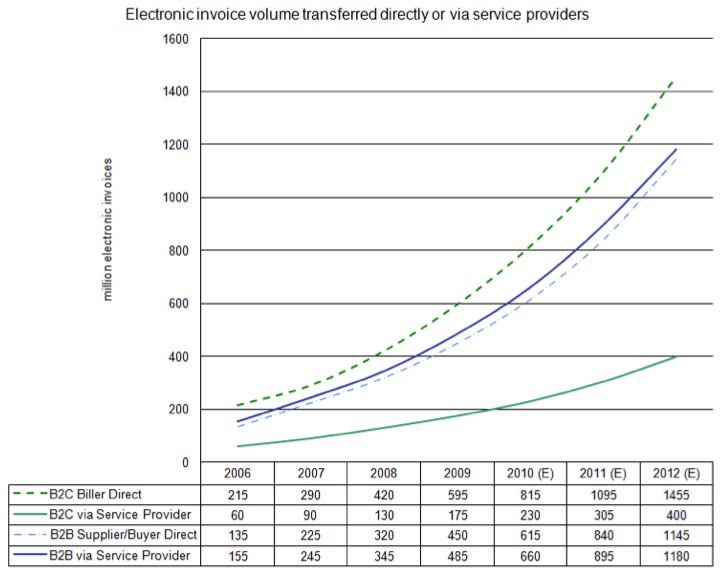
There is plenty of anecdotal evidence that 2011 is a big year for e-invoicing. Some new research published by Billentis reveals the scale of the anticipated growth in Europe.

Strong growth in e-invoicing predicted (Source: Billentis)

Strong growth in e-invoicing predicted (Source: Billentis)

Both in the business-to-business (B2B) and business-to-consumer (B2C) spaces, exponential growth is predicted in 2011 and 2012. e-invoicing between businesses will grow from a relatively modest 915 million in 2009 to nearly 2.5 billion in 2012 according to the Billentis research.

Consolidation in the e-invoicing market

The provider market is also likely to grow. According to Billentis, mergers and acquisition with grow from 14 in 2010 to 25 in 2011 with major consolidation expected if the market penetration of e-invoicing passes 15%

Visa adquirirá la compañía PlaySpan


Visa ha anunciado recientemente que ha llegado a un acuerdo para adquirir la compañía PlaySpan, una plataforma de pagos que se encarga de manejar transacciones sobre bienes digitales para juegos online, medios web, redes sociales  y en general ventas por Internet. La cifra de la transacción es de 190 millones de dólares.

Esta adquisición complementa la compra de CyberSource en el año 2010 consolidando el papel de Visa en el comercio electrónico tanto en el ámbito convencionalcomo en el móvil.

Se estima que en 2010 las ventas de comercio electrónico a nivel mundial ascendieron a 948 mil millones de dólares mientras la crisis ha hecho disminuir o estancarse las transacciones presenciales.  Mientras tanto PlaySpan se ha consolidado como líder en el comercio de bienes digitales, un segmento que ronda los 25.000 millones de dólares  a nivel mundial durante el 2010  y con espectativas de alcanzar los 280.000 millones de dólares en 2013.

PlaySpan ofrece la posibilidad de comprar créditos o monedas virtuales en línea a través de diferentes métodos como Paypal, DineroMail, ToditoCash, Wallie-card y Ultimate Points. También ofrece su “Ultimate Game Card” através de 20.000 distribuidores (incluyendo 7-Eleven, Wal-Mart, Blockbuster y Rite-Aid).

Entre las distribuidoras de videojuegos que ofrecen bienes virtuales se encuentra EverQuest, EVE Online, y todos los juegos de EA entre otros, sin mencionar que también se pueden comprar créditos para Farmville.

PlaySpan fundada en 2006 tiene su sede en Santa Clara, California y espera que su adquisición culmine este año durante el segundo trimestre fiscal de Visa.

Noticia deVisa to Acquire PlaySpan (Playspan – PDF)

XML Cryptographic Security and Suite B


Several years ago, on 25 sept 2007, Sue A. Roddy (NSA), presented the article «XML Cryptographic Security and Suite B» in the XML Security Futures Workshop, urging the industry to develop Eliptic Curve Cryptography solutions that could be used commercially and also by government agencies.

This is the Article:

Background:

The Department of Defense (DOD) through the leadership of the Defense Information Security Agency (DISA) is pushing forward to use the Extensible Markup Language (XML) as a key element of the DOD information sharing effort. The National Security Agency (NSA), in support of the DOD, is interested in seeing XML security evolve in a manner that provides extensive interoperability between XML systems and use cryptographic mechanisms that meet the stringent security requirements of the DOD.

The NSA has established a suite of cryptographic algorithms, drawn from published standards established by the National Institute for Standards and Technology (NIST), as a primary basis for DOD cryptographic security in the 21st century. This suite of algorithms has come to be called, “SUITE B.” To promote interoperability among DOD elements and to maximize the DOD’s ability to utilize commercial technology in satisfying their mission, NSA encourages all commercial vendors to incorporate Suite B in their products. In particular NSA would like to see XML standards emerge which support the use of Suite B.

Suite B Defined

The sustained and rapid advance of information technology in the 21st century dictates the adoption of a flexible and adaptable cryptographic strategy for protecting national security information. Several years ago, the Committee for National Security Systems (CNSS) issued a policy stating that the Advanced Encryption Standard (AES) could be used to protect both classified and unclassified National Security information. However, because a single encryption algorithm could not satisfy all of the needs of the national security community, NSA created a larger set of cryptographic algorithms which could be used along with AES in the systems used by the DOD and other national security users. The NSA announced Suite B at the 2005 RSA Conference.

In addition to the AES, Suite B includes cryptographic algorithms for hashing, digital signatures, and key exchange. The entire suite of cryptographic algorithms is intended to protect both classified and unclassified national security systems and information. Because Suite B is also a subset of the cryptographic algorithms approved by NIST, Suite B is also suitable for use throughout the U.S. government. NSA’s goal in presenting Suite B is to provide industry with a common set of cryptographic
algorithms that they can use to create products that meet the needs of the widest range of US Government (USG) needs.

However, Suite B only specifies the cryptographic algorithms to be used. Many other factors need to be addressed in determining whether a particular device implementing a particular set of cryptographic algorithms should be used to satisfy a particular requirement.

Today SUITE B includes:

The original policy on AES use states that AES with either 128 or 256-bit keys are sufficient to protect classified information up to the SECRET level. In addition, other controls on manufacture, handling and keying are anticipated. These same key sizes are suitable for protecting both national security and non-national security related information throughout the USG.

Consistent with this policy, Elliptic Curve Public Key Cryptography using the 256-bit prime modulus elliptic curve as specified in FIPS-186-2 and SHA-256 are appropriate for protecting classified information up to the SECRET level. Use of both the 384-bit prime modulus elliptic curve and SHA-384 is necessary for the protection of TOP SECRET information.

Intellectual Property on Suite B:

Associated with most cryptographic algorithms, even those found in standards, are patents on various ways of implementing the cryptography in particularly efficient or novel ways. Although there are some particular implementations of both the advanced Encryption Systems and Secure Hash Algorithm that are patented, the basic algorithms are available worldwide for royalty free use.

Another key aspect of Suite B is its use of elliptic curve technology instead of classical public key technology. NSA has determined that rather than increase key sizes beyond today’s current 1024-bits, a switch to elliptic curve technology is warranted.

Like the AES and SHA there are no fundamental patents on elliptic curve cryptography, however, there are a number of
patents covering various aspects of elliptic curve technology and implementations. Certicom, the largest holder of elliptic curve patents, states on their company website that licensing their patents is not necessary for implementing elliptic curve cryptography. Rather, they state that they have patents on what they believe to be some of the “best ways to implement elliptic curve cryptography (ECC).”

In order to facilitate adoption of Suite B by industry, NSA has licensed the rights to 26 patents held by Certicom Inc. covering a variety of elliptic curve technology. Under the license, NSA has a right to sublicense vendors building equipment or components in support of US national security interests. While NSA offers vendors royalty free licenses for the use of these patents, NSA is not suggesting that licensing any of these patents or any other patents is necessary for implementing Suite B.

Conclusion:

To master the information space, DOD and the IC need to be able to share, analyze and secure vast amounts of information. In order to prevent all of the information in DOD networks from becoming a meaningless tower of babel, standards such as XML are critical. NSA would like to see security for XML evolve in a manner that supports the DOD’s need for secure information sharing. To that end, NSA would like to see the adoption of Suite B cryptography as a security option for XML.

Inseguridad jurídica en la energía fotovoltáica


Un estado de derecho se debe de caracterizar por la seguridad jurídica. Si las disposiciones que aparecen en el BOE se modifican cada dos por tres sin necesidad aparente, se demuestra en cada modificacion que las normas que se cambian estaban mal en primer lugar. Pero es que además, cuando afecta a decisiones económicas, cada cambio es un cambio de reglas de juego en mitad de la partida. El dislate llega al máximo cuando se imponen modificaciones con efectos retroactivos.

Esto es lo que ha pasado en el mundo de la energía fotovoltáica, y que ha dado lugar a la movilización de los afectados por la nueva normativa de placas fotovoltaicas.

La situación se resume muy bien en el artículo las consecuencias e implicaciones del RD-Ley 14/2010 del bufete Navas & Cusí Abogados que reproduzco:

Las consecuencias e implicaciones del RD-Ley 14/2010

En el año 2007, el Gobierno español incentivó y fomentó el uso, producción y venta de energías renovables alternativas, fomentando especialmente la inversión en plantas fotovoltaicas de energía eléctrica. Para ello, aprobó el Real Decreto 661/2007 mediante el cual se incentivó la colocación de plantas fotovoltaicas asegurando la inversión
realizada estipulando un precio fijo por el que las compañías eléctricas compraban la totalidad de la energía eléctrica generada por dichas placas fotovoltaicas.

Ante la garantía y seguridad ofrecida por el Estado, cientos de personas invirtieron sus ahorros en la instalación de plantas
fotovoltaicas, tanto por estar en la creencia de que el gobierno deseaba crear una auténtica fuente eficaz de energía alternativa, como por la seguridad que otorga contratar con el Estado.

El pasado viernes 24 de Diciembre de 2010 se publicó en el BOE el Real Decreto-Ley 14/2010 mediante el cual el gobierno, de forma unilateral y sin consultar a los afectados e interesados del sector, aplica medidas económicas con carácter retroactivo que afectan a todos los inversores con plantas fotovoltaicas, sin diferenciar entre los productores hasta la actualidad y los nuevos productores con posterioridad al Decreto,  limitando las horas de producción eléctrica e instaurando un peaje transitorio de acceso a las redes de transporte y distribución a satisfacer por los productores de energía eléctrica.

En resumen:

  • Los propietarios de plantas fotovoltaicas estarán obligados, a partir del 1 de enero de 2011 y hasta que no se desarrolle un reglamento que imponga otros precios, a pagar un peaje de acceso por distribuir la energía eléctrica de 0,5 €/MWh.
  • Se procede a limitar las horas de funcionamiento de las instalaciones fotovoltaicas hasta el 31 de Diciembre de 2013. Las limitaciones para las instalaciones fotovoltaicas reguladas por el Real Decreto 661/2007 serán los siguientes, según su tecnología:
> Instalación fija: 1.250 horas equivalentes de referencia / año
> Instalación con seguimiento a 1 eje: 1.644 horas equivalentes de referencia / año
> Instalación con seguimiento a 2 ejes: 1.707 horas equivalentes de referencia / año

El presente Real Decreto comportará grandes perjuicios y pérdidas económicas a los inversores, quienes decidieron realizar la inversión amparados en unas determinadas condiciones que actualmente el Gobierno ha  modificado de forma unilateral y sin respetar las condiciones contractuales pactadas, dado que no podrán recuperar la inversión realizada en el tiempo estimado por limitar el Gobierno la producción de energía eléctrica y dejar de pagar los importes y los KW estimados.

Dicho Real Decreto y sus disposiciones transitorias pueden afectar a principios constitucionales básicos como son la seguridad jurídica, la responsabilidad y la interdicción de la arbitrariedad de los poderes.

Certificados duales RSA – ECC (enmarcados en el ENS)


EADTrust ha iniciado una campaña de promoción de certificados electrónicos según un nuevo modelo. En vez de entregar un solo certificado, entrega dos. El primer certificado, RSA, con clave de 2048 bits puede ser utilizado de forma convencional, en servidores SSL. El segundo (vinculado con el primero por una regla de generación cruzada) cumple los principos Binum. Es un certificado ECC con clave de 256 bits (robustez equivalente a 3070 bits en claves RSA) y se utiliza también en servidores SSL.

Los certificados se entregan en formato PKCS#12 y la generación de claves (llevada a cabo por EADTrust) verifica las recomendaciones contra los ataques matemáticos identificados en la literatura académica. Los certificados tienen una duración de 3 años, por lo que requieren menos esfuerzo de gestión (que los certificados anuales). El precio de los certificados (de cada pareja) es de 99 euros si identifican un dominio y 199 euros en el caso de pareja de certificados multidominio (*). Hasta el 30 de junio de 2011, el coste de cada pareja de certificados será de 50 y 100 euros respectivamente.

Dado que los certificados ECC no los soportan todos los navegadores, ayudamos a las entidades solicitantes a configurar los servidores de forma que se usen los algoritmos más potentes que soporte cada navegador, combinando ambos certificados.

Compruebe si su navegador soporta ambas tecnologías instalando los certificados raíz de las dos jerarquías de certificación:

El uso de claves largas en RSA (al menos de 2048 bits) y el empleo de algoritmos ECC como ECDSA son algunos de los aspectos recomendados por el CCN (Centro Criptológico Nacional) en la documentación de seguridad relativa a la implantación del Esquema Nacional de Seguridad. En particular, el documento Guía 807 – Criptología de empleo en el Esquema Nacional de Seguridad estudia los diferentes alguritmos y sus ataques conocidos y hace recomendaciones sobre los más adecuados en función del objetivo perseguido (identificación, autenticación, cifrado, firma, confidencialidad en SSL,…)

También hay recomendaciones equivalente en los documentos de la administración nortemaericana NIST (National Institute of Standards and Technology) FIPS (Federal Information Processing Standards) 186 -2 y FIPS 186-3 respectivamente en los apéndices 6 y D en las secciones Recommended Elliptic Curves for Federal Government use (United States).

A nivel europeo, las especificaciones que tratan sobre los algoritmos criptográficos que se usan para firma electrónica (por ejemplo) se describen en el documento ETSI TS 102 176-1 V2.0.0 (2007-11) “Technical Specification. Electronic Signatures and Infrastructures (ESI); Algorithms and Parameters for Secure Electronic Signatures; Part 1: Hash functions and asymmetric algorithms».

Otras normas aplicables:

  • RFC 3278 «Use of Elliptic Curve Cryptography (ECC) Algorithms in Cryptographic Message Syntax (CMS)»
  • RFC 4050 «Using the Elliptic Curve Signature Algorithm (ECDSA) for XML Digital Signatures»
  • RFC 4051 “Additional XML Security Uniform Resource Identifiers (URIs)”
  • RFC 4492 “Elliptic Curve Cryptography (ECC) Cipher Suites for Transport Layer Security (TLS)”
  • ISO/IEC 15946 “Information technology — Security techniques — Cryptographic techniques based on elliptic curves”
  • ANSI X9.62:2005 “Public Key Cryptography for the Financial Services Industry, The Elliptic Curve Digital Signature Algorithm (ECDSA)”

Otras referencias a EADTrust en este Blog:

Actualización: A partir de 2020, solo se entrega el certificado solicitado. Las peticiones de certificado deben incluir el tipo de criptotografía deseado, que puede llegar a 8192 bits de tamaño en RSA y 384 bits en ECC.

Mejoras en el soporte de OpenSC para el DNIe en Linux y Mac,


Muy buenas noticias estos dias para el DNIe y la posibilidad de usarlo en algunas plataformas en las que era un poco más complicado.

Primero, un aplauso para Jonsy Gaviota (Juan Antonio Martínez – EB4GPE) y su trabajo OpenDNI.

Segundo la Compilación de OpenDNIe para Mac OS X del Blog Cajón de sastre de Kounch

Gracias por vuestro esfuerzo.

CIR Technical Working Group


The EMV standards developed and maintained by EMVCo are the technical basis for card-based payment systems in many countries. The CIR (Common Implementation Recommendations) Technical Working Group is an open standardisation initiative of EMV implementers in Europe and acts as the technical reference group for the European EMV Users Group and the European members of the EMVCo Board of Advisors. The CIR Technical Working Group is not meant to duplicate any efforts at EMVCo level, but to complement the work at EMVCo by the input of technical experts who are actively involved in the deployment of the EMV specifications.

Participants of the CIR Technical Working Group are

The CIR Technical Working Group is supported by the observers

The aim of the CIR Technical Working Group is to come to harmonised technical specifications for EMV implementations for any card-based payment system. The work is not intended to change the EMV specifications but to fill in the «grey areas» of the EMV specifications and to reduce both the effort necessary to implement cards and terminals as well as the number of different implementations, thus allowing for less expensive devices.

The work of the CIR Technical Working Group started in 2003 with the objective of harmonising EMV implementations on cards. Based on this preparatory work, and with the support of the CIR Technical Working Group, EMVCo set up the Common Core Working Group (CCWG) which produced the EMVCo Common Core Definitions (CCD) and the EMVCo Common Payment Application (CPA) Specification, which allow a common EMV implementation on cards for all payment systems.

As a next step, the CIR Technical Working Group, in coordination with the European EMV Users Group, produced a set of common implementation recommendations for terminals, in the form of detailed flow charts describing the terminal behaviour, to clarify and enhance the EMV specifications and to improve interoperability. These Common Implementation Recommendations for Terminals have been reviewed with EMVCo and are the basis for the current work of the CIR Technical Working Group on a detailed terminal specification.

Starting in 2007, the CIR Technical Working Group has been working for the European Payments Council (EPC) Cards Working Group as Identified Initiative for the Card-to-Terminal and Cardholder-to-Terminal standardisation domains. The Functional Requirements in the European Payments Council (EPC), SEPA Cards Standardisation «Volume» are based on the input of the CIR Technical Working Group.

The CIR Technical Working Group works in close cooperation with other standardisation initiatives, such as EPAS, which concentrates on the Terminal-to-Acquirer interfaces, and CAS, which concentrates on the requirements for mutual recognition of certifications.

Los 902 y sus equivalentes de teléfono fijo


Ayer, mientras me cercioraba de los números de teléfono a los que hay que llamar para comunicar la pérdida o el robo de tarjeta, di con varios sitios web interesantes que informan sobre la equivalencia de números de teléfono de forma que se pueda evitar llamar a los 901 y 902 de la red inteligente y se pueda llamar en su lugar a números de telefonía fija equivalentes.

Cuando aparecieron los servicios de red inteligente, la ventaja de ofrecer servicios de call center por un número fácil de recordar y con una tarifa más ventajosa para los que llamaban desde otra provincia hizo que se popularizaran. Ahora que es frecuente que los usuarios cuenten con tarifas planas, los números especiales han pasado a suponer un problema, porque su tarificación es separada del resto de llamadas, y, a veces llega a ser significativa, encareciendo la factura.

Actualización 2013: Pasados los años, este artículo ha sido uno de los más leidos del blog y me ha parecido buena idea aprovecharlo para que los lectores conozcan iniciativas con las que colaboro: Atenea Interactiva Formación en nuevas tecnologías para empresas,  EAD Trust Prestador de servicios de Certificación, Noticeman Notificaciones certificadas, Convocatorias de Juntas de accionistas via web Servicios societarios electrónicos.

Y seguidamente incluyo una selección de teléfonos de interés y sus equivalentes, obtenida en «Ahorradores«:

  • Abogacía:
    • LEGÁLITAS (902-900-777) = 91 837 38 14
  • Coches:
    • RENAULT asistencia: (902 35 02 00) = 93 488 37 27
    • RENAULT: (902 333 500) = 91 468 88 58 / 91 302 33 54
    • CITROEN: (902 445 566) = 91 585 11 00
    • SEAT: (902 402 601) = 91 594 94 48)
    • SEAT  (Averias: RACE): (902 402 602) = 91 594 94 49
  • Hospitales:
    • HOSPITAL NUESTRA SEÑORA DE AMERICA: (902 50 01 12) = 91 214 31 00
    • SANITAS: (902 10 24 00) = 91 423 65 00
  • Supermercados y grandes almacenes:
    • TELECOMPRA MERCADONA: (902 350 200) = 963 88 33 28
    • EL CORTE INGLÉS atención al cliente: (901 122 122) = 91 724 36 99 / 91 401 85 00
    • CARREFOUR Atención al Cliente: (902 20 20 00) = 91 490 88 90
    • CARREFOUR Pass: (902 93 12 87 / 902 21 21 01) = 91 468 91 94
  • Bancos:
    • ING Clientes: (901 10 51 15) > 91 634 92 22
    • ING No clientes (901 02 09 01) = 91 634 92 80
    • LA CAIXA : (902 33 43 34) = 93 495 39 98
    • CAIXA DE CATALUÑA: (901 10 11 12) = 93 378 66 00
    • UNICAJA: (902 24 62 46) = 952 07 62 63
    • BANCO SANTANDER: (902 24 24 24) = 91 709 85 20
    • CAJA MADRID oficina telefónica: (902 10 20 10) > 91 334 93 00
    • CAJA MADRID centro de atención al cliente: (902 24 68 10 > 91 602 46 80
    • BBVA línea bbva: (902 22 44 66) = 91 537 63 22 / 91 374 73 68
    • BBVAnet: (902 18 18 18) = 91 374 73 68
    • BANESTO: (902 303 309) = 91 334 26 42
    • UNO-E BANK: (901 11 11 13) = 91 360 60 80
    • OPENBANK:Teléfono para Clientes (901 247 365) = 91 330 90 00
    • LA CAIXA Línea Abierta Personal(Banca Telefónica): (902 20 02 02)> 93 495 39 99
    • BANKINTER: (902 36 55 63) > 91 657 88 69
    • BANCO POPULAR (banca Telefonica): (902 36 55 55) = 91 436 50 00
    • CAJAMURCIA EMERGENCIAS: (902 24 07 12) = 968 36 13 27
    • CAJA CAMINOS: (902 100 845) = 91 310 95 50
    • DEUTSCHE BANK: (902 24 01 24) = 91 537 63 22 / 91 374 73 68
    • CAIXA ENGINYERS – CAJA DE INGENIEROS – TELEINGENIEROS-FONO: (902 20 08 88) = 93 310 26 26
    • BANCO CAIXA GERAL: (902 36 76 21) = 91 754 78 09
    • CAJA ESPAÑA: (902 365 024) = 987 27 71 00
    • BANCORREOS: (902 33 73 38) =93 366 51 01
  • Tarjetas
    • TARJETAS EURO6000 EMERGENCIAS: (902 20 60 00) = 91 596 53 35
    • TARJETAS SERVIRED: (902 19 21 00) = 91 519 21 00
    • TARJETAS 4B EMERGENCIAS: (902 11 44 00) = 913626200
    • Younique Money: (902006321) = 918299290
  • Seguros:
    • MUTUA MADRILEÑA: (902 555 550) = 91 557 82 00 / 91 592 25 00
    • AUTOCLUB MUTUA: (902 442 000) = 91 557 82 05
    • LÍNEA DIRECTA: (902 32 13 21) > 91 807 20 00
    • MAPFRE Clientes: (902 13 65 24) > 91 581 63 00
    • MAPFRE ASISTENCIA INTERNACIONAL: (902 44 88 44) = 91 581 18 18
    • ZURICH: (902 33 05 33) = 93 267 10 20
    • ZURICH (S.Hogar): (902 21 02 12) = 93 267 10 51 y 932 67 10 56
    • ZURICH (S.Coche): (902 11 03 30) = 91 327 72 61 / 91 327 75 35 / 91 327 75 62 / 91 327 75 80 / 93 561 71 64
    • ANTARES: (902 36 06 94) = 91 384 04 94 y 93 254 14 24
    • AXA Atención al Cliente: (902 40 40 84) = 91 807 00 55
    • AXA Siniestros Automóviles : (902 21 21 05) = 91 807 00 50
    • AXA Siniestros de Hogar, Comercio, Oficinas, Comunidades: (902 21 21 23) = 91 807 00 51
    • AXA Centro de Reclamaciones y Quejas: (902 21 21 44) = 91 807 00 55
    • CASER ASISTENCIA: ( 902 36 65 05) = 900 46 04 60
    • ADESLAS DENTAL MADRID: (902 53 09 53) = 91 429 34 26 y 91 429 66 96
  • Suministros de gas y electricidad:
    • IBERDROLA atención al cliente: (901 20 20 20) : 91 364 88 88
    • IBERDROLA Averías: (901 22 02 30) = 944 15 14 11 / 91 153 46 00
    • AQUALIA Averías: (902 13 60 13) = 98 579 41 21
  • transporte:
    • RENFE: (902 320 320) = 91 184 24 02
    • METRO Información: (902 44 44 03): 91 779 63 99 / 91 303 86 50 / 91 303 86 54 / 91 303 90 42
    • AIRMADRID información y reservas: (902 51 52 51) = 91 201 60 40
  • Telefonía:
    • ADSL TELEFONICA (902 35 70 00) = 91 707 74 60
    • TELE 2: (902 99 88 77) = 800 76 07 70
    • MOTOROLA: (902 20 23 02) = 91 413 89 93
    • TERRA: (902 15 20 25) = 91 453 28 40 / 91 327 76 86 / 91 452 30 00
    • ORANGE: (902 01 22 20) : 923 04 93 61 o 900901213
    • YA.COM: (902 90 29 02) = 91 291 05 20
    • ONO: (902 929 000/902 500 060) = 96 322 83 47 / 96 300 04 43/96 322 83 70 / 96 322 83 39
  • telentradas:
    • Telentrada: (902 10 12 12) = 93 326 29 32 / 93 326 29 45
  • Organizaciones:
    • OCU Información: (902 30 01 87) = 91 300 00 45
    • OCU Administración: (902 30 01 88) = 91 300 91 54
    • OCU Asesoría fiscal: (902 30 01 89) = 91 300 91 53
    • OCU Asesoría judicial: (902 11 94 79) = 91 300 91 51
  • Organismos oficiales:
    • HACIENDA (Información General): (901 33 55 33) = 91 423 20 11 / 93 484 10 09 / 93 484 40 04 / 954 24 56 05 / 954 34 99 39
    • HACIENDA (Información General): (901 20 03 45) = 91 584 81 80 / 93 274 64 45
    • HACIENDA (Declaración por teléfono): (901 22 22 50) = 91 540 81 80 / 93 274 64 46
    • HACIENDA (Inf. Devoluciones): (901 12 12 24) = 91 540 81 80 / 91 540 81 80-90
    • HACIENDA (Cita Previa) : (901 22 33 44) = 91 324 58 71 / 91 744 22 03 / 91 744 22 12 / 91 744 22 26 / 91 744 22 28 / 91 744 22 35 / 91 744 22 38 / 91 744 22 46 / 93 230 82 01 / 93 230 82 02 / 93 230 82 03 / 93 230 82 04 / 93 230 82 05 / 95 236 70 24 /
    • SEGURIDAD SOCIAL: (901 50 20 50) = 91 334 87 17 / 91 387 33 09 / 91 387 83 81 / 91 387 83 82 / 91 387 83 86 / 91 503 78 30 / 91 590 64 15 / 91 740 67 57 / 91 740 67 73 / 91 740 69 49 / 91 744 95 13 / 91 744 95 15
    • AYUNTAMIENTO DE MADRID Teléfono información: (010) = 91 529 82 10
  • Venta:
    • VENCA: (902 18 01 44) = 938 14 09 09
    • REVISTAS EN CASA: (902 36 38 72) = 91 564 34 25
  • Varios:
    • CORREOS: (902 19 71 97) > 91 387 33 14
    • LA VANGUARDIA ATENCIÓN AL SUSCRIPTOR: (902 48 14 82) = 93 481 24 92
    • MICROSOFT IBÉRICA: (902 19 71 98) = 91 353 69 60
    • INSTITUTO OFTALMOLÓGICO DE ALICANTE: (902 33 33 44) = 96 526 80 80
    • EL PAIS: (902 119 111) > 913 378 200

Para contactar con el autor de este artículo, el número «premium» es  902 365 6 12 que es fácil de recordar: 365 dias al año, 6 dias por semana, 12 horas al día . Y el de tarifa normal 91 716 0555.

EN ESTOS NÚMEROS NO PODEMOS INFORMAR SOBRE EQUIVALENCIAS DE NÚMEROS TELEFÓNICOS. DE VERDAD QUE NO PODEMOS

Otras fuentes de información de teléfonos 902 y sus equivalentes fijos: