Archivo de la categoría: Time stamping

Firma electrónica centralizada en servidor


El próximo 31 de mayo de 2011 se celebra en Barcelona (Hotel Abba Sants, C/ Numancia, 32 – 08029 Barcelona) el seminario «Firma electrónica centralizada en servidor. SOA, Cloud Computing, Software as a Service» organizado por Atenea Interactiva. El coste de inscripción es de 450 euros, pero resulta bonificado por la Fundación Tripartita (llame al 902 365 612 para conocer los detalles).

Este curso es una mejora del impartido en Madrid el pasado 5 de mayo con el título Firma Electrónica en Arquitecturas SOA. Servicios PKI.

Este es el programa previsto:

1. SOA – Service-oriented architecture

  • Introducción y conceptos SOA
  • El modelo de referencia SOA
  • Implementaciones SOA (SOAP y REST)
  • Software as a Service. Cloud Computing. La(s) nube(s), privadas y públicas.

2. Cumplimiento de obligaciones con SOA

  • Sector Privado: La Interlocución Telemática de la Ley 56/2007 con SOA
  • Sector Público: La Administración Electrónica de la Ley 11/2007 con SOA

3. Conceptos de firma electrónica y PKI

  • Conceptos criptográficos
  • La firma digital
  • Los certificados digitales
  • La legalidad de la firma electrónica

4. PKI – Servicios Avanzados

  • TimeStamping – Sellos de Tiempo
  • Validez de certificados
  • Firmas “básicas” y firmas “completas”
  • Firmas “remotas”

5. La firma digital como elemento de arquitectura

  • Introducción. Cambio de paradigma.
  • Gestión segura de claves. Dispositivos hardware criptográficos.
  • PKIs internas.
  • Los servicios de firma digital
  • El estándar DSS.
  • La firma asíncrona (portafirmas).

6. Formatos y estándares de firma

  • Tipos de firma “legales”
  • Formatos básicos
  • Firmas “longevas”
  • Formatos AdES (XAdES, CAdES y PAdES)
  • Políticas de firma

7. Firma electrónica en las Administraciones Públicas

  • La firma electrónica en la Ley 11/2007, el ENI y el ENS. Norma CCN-STIC-807
  • Procesos de firma automatizados. Sello de órgano y CSV
  • Servicios de firma y validación disponibles para Administraciones Públicas
  • Políticas de firma en las AAPP. Descripción y diseño.
  • Interoperabilidad. TSLs. Proyecto Stork

8. Identidad Digital

  • La identidad digital en Internet. Identidad 2.0
  • Los sistemas de federación de identidades
  • Los sistemas “fuertes” de autenticación

n

Appliance de firma electrónica


Ya está disponible en formato appliance (y prácticamente con Configuración Cero) el aclamado sistema de firma electrónica BackTrust que permite a los organismos públicos cumplir con la Ley 11/2007 y a las entidades privadas poner en marcha el sistema de interlocución telemática al que les obliga la Ley 56/2007.

Hoy presentamos la variante xBackTrust, construida en torno a un equipo base de IBM x3650 y reforzado criptográficamente con placas IBM 4764 o Safenet Luna PCI.

El xBackTrust Appliance de Firma Electrónica gestiona firmas completas XAdES-XL y firmas PDF. Las genera, comprueba, prepara para el almacenamiento a largo plazo. Maneja TSA facilitando el uso de timestamping a través de protocolo OASIS DSS. Comprueba la validez de los certificados de cualquier prestador español o europeo. Es compatible con @firma y EADTrust.

Public Consultation on Electronic identification, authentication and signatures


As always, the last day comes quickly without enough time to prepare a sound document.

But tomorrow is the last day for this consultation and I though that my opinion could help to others.

Public Consultation on Electronic identification, authentication and signatures

1. Respondent information

Are you replying: On behalf of an organisation
Please provide the name of your Organisation
EAD Trust, European Agency of Digital Trust
Please provide if applicable, your interest Representative Register ID number
Please indicate which type of stakeholder you are Small or medium-size enterprise
Please provide your Name and Surname
Julian Inza
Please provide your email address
julian@eadtrust.com
Your country of residence Spain

2. General expectations regarding EU legislation on e-signatures, e-identification and e-authentication

Question 1: Do you / Does your organisation use e-signatures, e-identification and e-authentication?

yes
If yes, what are your specific needs? Secure transactions
Unambiguous identification of contract partners
Integrity of electronic documents
Legal effect
Legal effect, contract signatures in particular
User convenience
Others
Please comment why
Electronic invoice, electronic documents of all kinds, electronic evidence

If yes, how frequently do you carry out secure transactions?

Daily

Question 2: For what online transactions do you consider electronic identification, authentication and signatures useful in coming years?

eGovernment services
Electronic Public Procurement
eCommerce transactions
eBusiness transactions
Online banking and financial transactions
Issuance of authentic electronic documents
Secure archiving or storage of authentic electronic documents
Others
Please comment why
electronic invoices, secure identification in social networks, electronic banking, web services, automated electronic seals,…

Question 3: What socio-economic benefits or drawbacks do you expect from the use of electronic signatures, identification, and authentication in other sectors of activity than yours?

A huge improvement in efficience and costs reductions. More security, more convenience, tele-operations of all kinds
Question 4: Would a stronger involvement of financial institutions in the provision of trusted e-signature and e-identification services have an impact on the take-up of e-signature and e-identification in other sectors? yes

If yes, what would be the appropriate incentives?

A simpler way to manage revocation information of certificates and to define trusted root certs and chain of trust&nbsp
Question 5: Do you think that there are specific interoperability or security aspects that should be taken into account to foster the use of electronic signatures, identification and authentication through mobile devices (e.g. requirements on the SIM cards, on the handset, on the mobile operator)? yes
If yes, regarding: operational
technical

Question 6: For which of the following trust building services and credentials should legal or regulatory measures be considered at EU-level in order to ensure their cross-border use and why?

Electronic seals
Time stamping
Long term archiving
Certified delivery of mail
Pseudonyms
Certified electronic documents in general
Others (please list)
Please list
Long term accesible digital custody /electronic chartulary /electronic headoffice /secure verification code / certification validation services

3. e-signatures tailored to face the challenges of the digital single market

Question 7: How do you judge the take-up of electronic signatures in Europe?

Very high
Please comment why
Citizen ID cards are being adopted in advanced countries, which include 2 or more certificates. Virtuous circle fosters the creation of adapted services
Question 8: Which of the following issues have a negative impact on the uptake of e-signature? You may select up to three answers that have according to you the most important impact. Lack of user-friendly signature solutions
Others
Please comment why
Poor solution for trust discovery of roots CA, bad implementations of OCSP in AIA extension of certificates, insufficient use of timestamping / not enough use of complete (AdES_XL) signatures, legacy management of CRLS to OCSP responses (bound to grace period), excesive use of CRLs for validation

Question 9: Which of the following specific issues have an impact on cross-border interoperability of e-signatures in Europe and should be addressed in a revised legal framework on e-signature (the references point to the articles and annexes of the eSignatures Directive)?

Unclear terminology in Directive 1999/93/EC and heterogeneous terminology in national legislations
Heterogeneous approach to security requirements (e.g. certification requirements on the signing software in some countries)
Insufficient harmonisation of profiles of qualified certificates
Other
Please comment why
Lack of clear definition of electronic seal for legal persons, lack of clear definition of codes to inform about power of attorney in certificate extensions, unclear effect of qualified certificates without secre signature creation devices, lack of clear definition of automated signature&nbsp

Question 10: Which among the following options could be solutions for signature verification and validation at EU level?

Other
Please comment why
Common list of OCSP services and timestamping services for all Trusted CAs in Europe. Signature software that creates always AdES-XL signatures including Timestamping and OCSP validation, getting the OCSP address from the AIA field of the certificate. OCSP services with grace period=0, supplied by the CA issuing certificates or a entity in its behalf, forbid the use of CRL for validation purposes. Relying party software that verifies XL signatures, Digital custody for secure storage of signatures,
Question 11: Do you have specific expectations from e-signature standardisation to cover? Mass signature (server signing)
Mobile signature creation devices
Remote signature
Others
Question 12: Do you use «qualified» e-signatures? yes
If yes, how often per month and for which kind and value of transactions?
3/4 per month. Transactions not connected to value. I believe transaction amount limits are relevant only to a few kinds of signatures.

Question 13: What is your view on the need to revise the security provisions of «qualified» e-signatures?

The current provisions should stay as they are

Question 14: Would a classification of a range of e-signatures be desirable to match different levels of security?

Yes, a classification would be convenient, it should be defined by law and a legal effect should be associated to each or some classes.
Please comment and explain for which usage a classification would be desirable.
legal person seal, automated signature, powers of attorney with use limits, SSL certificate with legal effects, sinonimous certificates and their effects, qualified certificates without SSCD. person associated to a company or government body acting in assigned role but not needing a representation letter or power
Question 15: Should «electronic consent» be recognised formally by future European legislation? yes

If yes, should legislation (where necessary supported by operational and technical standards) define specific requirements on:

Others
Please explain why
It is already recognized in standards and is named «content commitment». When a certificate has that bit activated, should verify a proof of consent, including a turing test demonstrating the user has read the message and asking clearly for consent. This kind of use should generate evidences for all involved parties and, where possible, an accesible digital custody (chartulary+electronic headoffice+secure verification code) receipt for them)
Question 16: Should «electronic consent» be considered as equivalent to electronic signatures? yes

Question 17: Are there specific aspects that should be taken into account to address electronic archiving?

yes
If yes, please specify the legal provisions which are needed in your opinion to address electronic archiving needs?
All electronic documents (signed or not) with legal effect, should be available under security considerations applied to archive (WORM), through a URL of trusted sites (electronc headoffice), with the help of a secure verification code. With additional measures for preserving privacy in specific cases, or to allow to be accessible to third parties for proof or evidential reasons. Paper documents or receipts withs URL and SVC, that can be verified against the electronis versions are considered trustworthy equivalent to authentic documents

4. Principles to guide e-identification and e-authentication in europe

Question 18: Do you see a need for additional legal or regulatory measures on electronic identification at EU-level? yes

If yes, in your opinion, what are the general principles that should underlie the legal provisions on the mutual recognition and acceptance of e-identification at EU-level?

Others
Please comment
compatibility&nbsp
Question 19: What effects for the digital single market do you expect from legal provisions on an EU-wide mutual recognition and acceptance of eID issued in the Member States? Legal certainty
Reduction of administrative burden
Other
Please comment why
Simplicity for citizen to exercise their rights in all countries, Convenience for citizens, efficience for government bodies and enterprises

Question 20: How could users provided with electronic identification and authentication means benefit from their mutual recognition and acceptance across Europe and in which sectors?

Increase of user convenience
Simplification of access to online services
Reduction of numerous UID/passwords
Reduced exposure to ID theft
Others
Please comment why
Use in day by day in non online services, to dematerialice paper

Question 21: What are the specific aspects that should be taken into account to achieve cross-sector interoperability of electronic identities?

Others
Please comment why
Common list of trusted CAs and their roots, Common profiles, common OIDs definitions, Correct codification of OCSP servers in AIA fields

Question 22: Please indicate experiences and lessons learned in the private sector that could be transferred to the public sector.

Please make everything EASY for the final user. And define a consistent user experience for all ID cards. Users then can detect if someone try to cheat them (identifying unusual use patterns)

5. Legislative measures for the challenges ahead

Question 23: What European Union legislative measures on e-signatures, e-authentication of natural and legal person claims as well as e-identification would be appropriate in your opinion to best meet the challenges of the digital single market?

Other
Please comment why
Reglament better than Directive. Clear rules. Clear language, Legal framework ligned with standards (standards are now better than law, but can not be used in the best way because law does not cover some technical uses)

6. Research and Innovation

Question 24: On what issues should EU R&D and standardisation focus to have all the necessary technology to improve eID management?

Nothing. A lot of money has been spent in past years without real improvement. We have standards. We should use them and in some cases improve them, with normal budget.

Question 25: On which technologies should Research & Development focus to improve the usability of e-signatures and electronic identification for end users and to facilitate the deployment for service providers?

Timestamping services, OCSP services, custodian services, registered notice services, mobile service, intelligent NFC services, interoperability services

Question 26: What technologies could contribute to overcoming the lack of trust in electronic identification, authentication and signatures in the European Single Market (ex. addressing the so-called «what you see is what you sign» issue)?

TSL, XAdES-XL, PAdES-LTV, writen signature digitalization with security measures binding the signature to the document in a way equivalent to «advance signature» with use of trusted third parties

7. Others

Question 27: Europe is fully part of the global economy. However, the forthcoming legal framework cannot cover non EU countries. Are there nevertheless international issues that should be taken into account?

The development of the legal framework must take into account existing standards or be compatible with future global standards. For instance RFC 3739

Question 28: Would you wish to share some best practices examples outside Europe?

Maybe connection of strong authentication with ID cards to federated identity systems (such as SAML) or simple authentication systems such as Open-ID can facilitate the use of Strong identity in social networks

Question 29: Are there any other issues which you think should be addressed by policy makers?

Yes. The use of ID systems and electronic signatures should be a strategic movement covering all kind of documents and sectors. In the past different lobbies or groups of interest have tried to convince EU policy makers to take out electronic signatures from electronic invoices to cite just one area. Electronic signatures should be used consistently in all areas or, at the end, exceptions will be greater that the rule and electronic signature can become useles or even worst, dangerous.
Meta Informations
Creation date
15-04-2011
Last update date
User name
null
Case Number
089674306510210511
Invitation Ref.
Status
N
Language
en

Duda sobre firmas AdES-XL


Mi amigo Daniel me hace llegar una duda sobre firmas AdES, pidiendo la opinión de los expertos.

Se tiene una firma XADES-XLong, que contiene la CRL correspondiente. Esta CRL no está sellada (es decir, no es una XLong-Type1 ni Type2). Si se verifica la CRL antes de que la CA publique una nueva CRL, el documento XADES-XLong es válido. Pero si se verifica una vez que la CA ha publicado una nueva CRL, entonces no, y yo no estoy de acuerdo con este último aspecto, ya que se está asumiendo que el documento firmado caduca en la fecha indicada por el nextUpdate de la CRL.

Para evitar mezclar el período de gracia, podemos asumir que la XADES se realizó el 1 de enero, se convirtió en XADES-T el 15 de enero, y se convirtió en XADES-XLong el 30 de enero. Y que la verificación se está intentando hacer hoy, 4 de marzo.

¿Creis que es correcto?

Daniel cree que el documento XLong seguirá siendo válido hasta que caduque uno de estos tres certificados

  • El certificado del usuario firmante
  • El certificado del sello de tiempo de la XADES-T
  • El certificado de la CA que ha firmado la CRL

Pero no que dejará de ser válido en la fecha nextUpdate de la CRL

Esta es mi opinión:

El documento firmado con XAdES-T indica que el certificado se usó para firmar con anterioridad a la fecha indicada en el Sello de tiempo.

Cada CRL lleva su fecha. Las CRL son documentos con validez derivada de política, no necesitan tener firmas avanzadas. La especificación es la RFC 3280, no están en formato XML.

Luego, si una CRL posterior al sello de tiempo indica que el certificado no está revocado, la firma completa es válida. Incluso si se indica que el certificado está revocado, si la fecha de revocación (incluida en la CRL) es posterior, la firma es válida. A todo esto, hay que considerar «el período de gracia» transcurrido entre la fecha del timestamping y la de la primera CRL «válida».

Y el Documento X-Long es válido para siempre si se custodia debidamente (que es la opción que yo prefiero) o si se refirma en XAdES-A cada 5 años.

El sello de tiempo es un documento con validez derivada de política y no caduca. La CA aunque caduque no afecta a las firmas hechas con certificados que eran válidos en el momento de la firma.

Animo a los lectores a dar su opinión.

BackTrust in CeBIT


We at Albalia are trying to discover our international market. We are going to be at CeBIT with several appointments with potential partners. We already have been at CeBIT last year, with our own booth, in the framework of the spanish pavillion.

We now focus on our BackTrust product. A complete suite that allow to dematerialize all kind of documents, and manage electronic evidences. The core sistema manages electronic signatures and digital custody, and is suitable to deploy eGovernment solutions, and also ebanking, eHealth, eCommerce and eDocuments.

Our solutions helps manage electronic signatures (in the sense of Directive 1999/93/CE), and also digitalized signatures, biometric proofs and electronic evidences (such as certified digitization), thus allowing to eliminate paper while preserving evidential proof of the electronic registers.

Our BackTrust suite is available on zEnterprise with the name zBackTrust, and it is the only electronic signature solution in the world for IBM mainframes (both for Linux for System z, and z/OS). The solution is certified by IBM and is already deployed in customers as NovaCaixaGalicia (see page 12).

Others of our solutions are also mentioned internationally:

  • The Albalia team is very active in Social NetWorks (in Spanish):
  • Mainframe supported electronic signature: zBackTrust


    Albalia is an IBM partner in the System z environment (now zEnterprise) that has developed the only SOA electronic signature solution for Mainframes running z/OS or zLinux

    This solution complies with standards such as OASIS DSS or ETSI TS 101 903.

    Find more in this zBackTrust brochure, and in  this IBM page.

    Contact your IBM dealer worldwide or though  INSA exclusive channel: www.insags.com— +34 901 116 376— soluciones@insags.com

    Cambio de hora


    Hoy es uno de esos dias en los que cambiamos la hora.

    A las 3:00 de la pasada madrugada se ajustaban las manecillas de los relojes para que señalaran las 2:00

    Esto siempre me trae reflexiones sobre NTP y timestamping, como los que ya he relatado en otras ocasiones:

    Extensiones de SIGEM


    SIGEM es una aplicación desarrollada bajo el auspicio del MITyC para la gestión de los procedimientos administrativos definidos por la Ley 30/1992 (LRJAP-PAC) en forma de expedientes administrativos, y sobre la que Albalia Interactiva da soporte técnico de instalación y despliegue, añadiendo funcionalidades a partir de la suite de gestión de documentos digitales con valor probatorio BackTrust y, en particular la gestión de  Notificaciones fehacientes, o la gestión de recepción de facturas electrónicas en formato facturae.

    Recientemente se ha publicado la versión 2.0, más adaptada a los cambios que ha supuesto la entrada en vigor de la Ley 11/2007 (LAECSP).

    SIGEM lo pueden instalar ayuntamientos y organismos públicos, con lo que permiten que el ciudadano pueda gestionar telemáticamente desde su domicilio la solicitud de una subvención, una ayuda, una licencia, o realizar un pago; recibir noticias del estado de su petición, o información sobre la falta de algún documento e indicaciones de cómo anexarlo, para recibir, finalmente, una notificación del resultado de sus gestiones.

    El uso de este tipo de software es un paso muy interesante para que los organismos públicos acometan su modernización dotándoles de un sistema, que pueda reunir en formato electrónico, toda la documentación de un expediente, integrando los tradicionales subsistemas de Registro, Motor de Expedientes (Flujos de procedimientos),  y Archivo. En esta relación con su Ayuntamiento, el ciudadano podrá identificarse utilizando e-DNI, firma electrónica, o claves concertadas, y en conjunto se  garantiza la confidencialidad y privacidad de los datos gestionados.

    El diseño original del sistema  corrió a cargo de Informática El Corte Inglés, que, como empresa adjudicataria para el desarrollo del proyecto SIGEM, recibió el encargo de elaborar la solución informática para la gestión de las administraciones locales.  IECI fue en su momento adjudicataria del proyecto Pista Ventanilla Única II, por lo que ha aportado al proyecto su experiencia en soluciones de registro telemático, gestión de expedientes, gestión documental y archivo, que ya se han implantado en numerosos organismos públicos.

    El sistema  integra los módulos de registro, expedientes, tramitación electrónica y archivo, y permite la consulta segura de la información particular de un interesado en un procedimiento administrativo concreto

    • El módulo de registro abarca la aplicación del registro de documentos de entrada/salida, que, entre otras utilidades, permite anexar documentos en formato electrónico; el sellado electrónico de documentos; la búsqueda/recuperación y almacenamiento de registros, la compulsa electrónica, etc.
    • El módulo de tramitación electrónica incluye los servicios de: registro telemático, pago electrónico, certificación electrónica y notificación telemática.
    • La gestión de expedientes simplifica y racionaliza los procesos administrativos que se tramitan en los entidades locales, e incorpora un catálogo de procedimientos, para el modelado de procedimientos y el diseño de fases y trámites; un motor de ”workflow” para la distribución, gestión y seguimiento del expediente; un entorno de tramitación, que es la “cara visible” de la gestión de expedientes para los usuarios; así como un entorno de publicación, que informa al ciudadano del estado actual de sus expedientes.
    • El módulo de archivo es la aplicación que realiza la catalogación electrónica de la documentación, de acuerdo a las normas de descripción y categorización archivísticas.

    En SIGEM, se incluyen tres procedimientos modelizados totalmente, que fueron seleccionados por el grupo de usuarios de ayuntamientos y diputaciones, de entre los más usuales en sus administraciones: procedimiento de licencia de obra menor, procedimiento de subvención y procedimiento de reclamaciones, quejas y sugerencias.

    SIGEM permite que los organismos pongan a disposición de los ciudadanos la posibilidad de  solicitar telemáticamente subvenciones, ayudas o licencias; realizar pagos; recibir noticias del estado de su petición; información sobre la falta de algún documento e indicaciones de cómo anexarlo, y, finalmente, la notificación del resultado de sus gestiones.

    En el desarrollo del proyecto original colaboraron el Ministerio de Administraciones Públicas (hoy Presidencia), la Federación española de Municipios y Provincias (FEMP) y usuarios de distintos ayuntamientos (como Utrera y Sanlúcar de Barrameda) y diputaciones (como Badajoz, Alicante y Almería). Se llevó a cabo en 14 meses,y en su desarrollo se utilizó  la metodología Métrica v3, del Consejo Superior de Administración Electrónica.

    Se adecúa a las siguientes especificaciones:

    • Norma ISO 15489, de Sistemas de gestión de documentos.
    • Norma ISO 14721, de Sistemas de gestión de documentos electrónicos de Archivo.
    • MoReq, (Modelo de Requisitos para los Sistemas de gestión de documentos electrónicos de Archivo).
    • Normas internacionales de descripción archivística ISAD (G)

    Algunos servicios como el sellado de tiempo o la firma electrónica centralizada a través de protocolo DSS, se integran facilmente con el prestador de servicios de certificación EADTrust.

    Período de gracia en las firmas XAdES-XL


    Debido al estado de desarrollo de los PSC cuando se redactaron algunas normas de firma electrónica, se tuvo en consideración el llamado «periodo de gracia para comprobación del estado de revocación de un certificado».

    En alguna de aquellas normas  se recomendaba tener en cuenta la existencia de un periodo de tiempo de espera, conocido como periodo de precaución o periodo de gracia, para comprobar el estado de revocación de un certificado. Por ello, toda la información de revocación en formatos AdES se recomendaba incluirla después de trascurrido el periodo de precaución o periodo de gracia desde la obtención del sellado de tiempo. Este periodo como mínimo debía ser el tiempo máximo permitido para el refresco completo de las CRLs o el tiempo máximo de actualización del estado del certificado en el servicio OCSP. Estos tiempos podrán ser variables según la Declaración de Prácticas de Certificación del Prestador de Servicios de Certificación.

    En la actualidad, está precaución no tiene sentido, especialmente cuando las firmas XAdES-XL se generan del lado del firmante y es este el que inlcuye los datos de timestamping y de validación basada en OCSP (y por tanto conoce si su certificado está revocado o no).

    Efectivamente, en la actualidad, la información sobre revocación de certificados que ofrecen los prestadores de servicios de certificación sobre OCSP incluyen de forma inmediata cualquier información de revocación que se produzca, en tiempo real.

    Sólo hay que tomar precauciones cuando se utilice como mecanismo de comprobación de la revocación el acceso a las listas CRL (un mecanismo obsoleto que solo se usa en algunos contextos) o cuando se utilice un servicio de validación que, aun siendo soportado por el protocolo OCSP, se basa en la consulta de CRLs para su funcionamiento.

    En España, los únicos certificados que podrían requerir el mantenimiento del período de gracia son los de FNMT-RCM, ya que en muchos casos siguen distribuyendo CRLs. Igualmente, cuando se utilice @firma como plataforma de validación, conviene cerciorarse que el servicio no esté basado en consulta de CRLs.

    EADTrust – European Agency of Digital Trust


    Logo EAD Trust As I mentioned in other articles, one of the companies with which I am working is EADTrust, European Agency of Digital Trust, a CSP (Certification Service Provider) that provides services related to electronic signatures in the framework of Law 59/2003 (or Directive 1999/93/CE) with a philosophy we intend to be innovative:

    • It is not planned to issue individual certificates to natural persons (we might consider issuing certificates to natural persons linked to groups as part of a project).
    • It provides services to manage trust of the Information Society, particularly by encouraging the creation of high quality electronic signatures with timestamping services, validation of digital certificates and electronic document custody.
    • It provides advanced services, some specifically designed for public administrations in the framework of eGovernment Law 11/2007: certified publication in the contractor’s profile, certified service of notice, electronic invoicing or generation and verification of electronic signatures through the OASIS DSS protocol (the Ministry of Presidence announced that the evolution of the official @firma platform will evolve to implement this protocol).
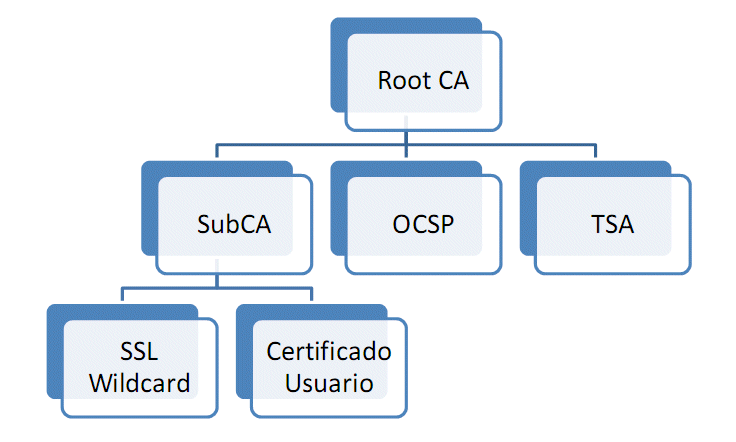
    • It manages two root CAs linked together, combining RSA cryptography and ECC (Elliptic curve cryptography).

    The latter is a significant milestone, since this way EADTrust becomes the first certification authority in the world with dual technology, and possibly the first European Certification Authority that manages a PKI hierarchy based on elliptic curve cryptography.

    The root CAs of both of the certificate hierarchies are as follows:

    • RSA (sha1RSA). RSA 2048-bit key size
    • ECC (sha1ECDSA). ECC key sizes: 256 bits (equivalent to 3020 bit RSA)

    Both root CA certificates and keys were generated in the presence of a notary, a procedure that we have been refining on several CA (Certification Authority) key generation ceremonies to other certification providers with whom we have collaborated: FESTE, Camerfirma, Banesto and ANCERT.

    The certification authority based on Elliptic Curve algorithm, uses random 256 BITS ECDSAFp (secp256r1), as indicated in the documents generated by the NIST (National Institute of Standards and Technology) FIPS (Federal Information Processing Standards) 186 -2 and FIPS 186-3 in Appendices 6 and D respectively in their sections on the Recommended Elliptic Curves for Federal Government use (United States).

    This algorithm is also described in document ETSI TS 102 176-1 V2.0.0 (2007-11) «Technical Specification. Electronic Signatures and Infrastructures (ESI); Algorithms and Parameters for Secure Electronic Signatures; Part 1: Hash functions and asymmetric algorithms».

    Other references:

    • RFC 4051 «Additional XML Security Uniform Resource Identifiers (URIs)»
    • RFC 4492 «Elliptic Curve Cryptography (ECC) Cipher Suites for Transport Layer Security (TLS)»
    • ISO/IEC 15946 «Information technology — Security techniques — Cryptographic techniques based on elliptic curves»
    • ANSI X9.62:2005 «Public Key Cryptography for the Financial Services Industry, The Elliptic Curve Digital Signature Algorithm (ECDSA)»