Archivo de la categoría: eInvoicing

e-invoicing: Huge Growth Predicted In Europe


As seen in Purchasing Insight.

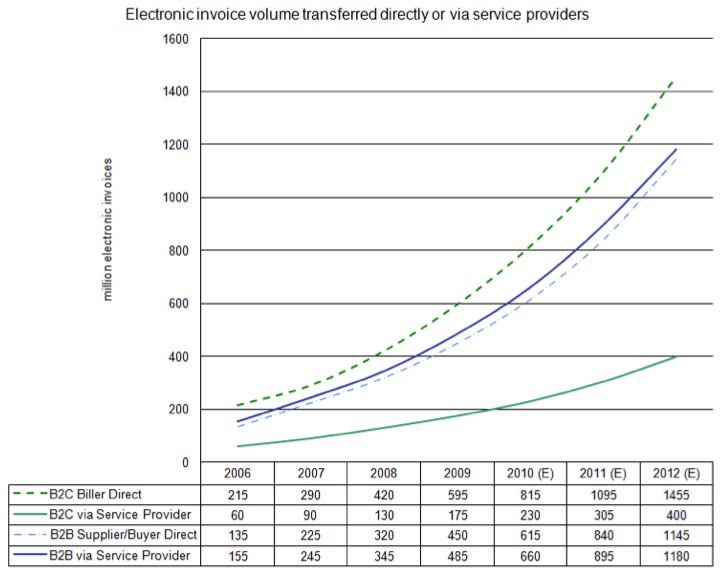
There is plenty of anecdotal evidence that 2011 is a big year for e-invoicing. Some new research published by Billentis reveals the scale of the anticipated growth in Europe.

Strong growth in e-invoicing predicted (Source: Billentis)

Strong growth in e-invoicing predicted (Source: Billentis)

Both in the business-to-business (B2B) and business-to-consumer (B2C) spaces, exponential growth is predicted in 2011 and 2012. e-invoicing between businesses will grow from a relatively modest 915 million in 2009 to nearly 2.5 billion in 2012 according to the Billentis research.

Consolidation in the e-invoicing market

The provider market is also likely to grow. According to Billentis, mergers and acquisition with grow from 14 in 2010 to 25 in 2011 with major consolidation expected if the market penetration of e-invoicing passes 15%

BackTrust, electronic signature suite


Spanish company Abalia has developed an Electronic Signature technology (Backtrust) as a system to different needs related with digital signature and digital custody of electronic documents. The system provides signature and validation tools in XML, CMS and PDF format available in different modules separately or as a whole pack. The obtained signatures include validation and time-stamping data in every format for a long term. The company is looking for commercial and licensing agreement.

See Profile and link in the Technology market section of Enterprise Europe Network

The Electronic Signature technology suite holds the following tools:

  • Batch Signer: A desktop tool that allows to sign several electronic documents in every batch. It supports versions to sign PDF and XML files such as electronic invoices (UBL, CII and other formats).
  • API: Integration tool for electronic signatures inclusion in the applications by developers. It supports versions for
    Microsoft .NET and Java.
  • WebSigner: Component of AdES basic electronic signature for Web sites.
  • BackTrust DSS Server: Electronic signature server based on OASIS DSS webservice standard.» PKI or Public Key Infrastructure servers: Certification authority, validation and timestamping authority.

Innovative Aspects:

The innovative Electronic Signature technology includes an integration API tool for electronic signatures in third party applications. Designed for software developers and integrators to help them to complete their applications with electronic signature services, its main key features are:

  • Microsoft .NET and Java standards availability.
  • Local signatures management through different keystores access. (i.e.: windows keystore, files in PKCS#12 format, HSM devices using PKCS#11 format).
  • It generates CMS, XMLDsig, PDF and XadES signature formats.
  • It generates complete signature format (XAdES-XL) by accessing to new company’s services.
  • Full integration with the other company developments and applications. Easy connection to other VA and TSA servers.
  • The system holds a specific version for electronic signatures in billing systems based on an invocing with security
    sytem format with specific signature policies compliance (XadES-EPES or XadES-XL).

Mainframe supported electronic signature: zBackTrust


Albalia is an IBM partner in the System z environment (now zEnterprise) that has developed the only SOA electronic signature solution for Mainframes running z/OS or zLinux

This solution complies with standards such as OASIS DSS or ETSI TS 101 903.

Find more in this zBackTrust brochure, and in  this IBM page.

Contact your IBM dealer worldwide or though  INSA exclusive channel: www.insags.com— +34 901 116 376— soluciones@insags.com

Directiva 2010/45/UE del Parlamento Europeo y del Consejo, de 7 de julio de 2010


Una curiosidad. Se trata de la Directiva 2010/45/UE del Parlamento Europeo y del Consejo, de 7 de julio de 2010.

Se trata de una colisión. Algo que, en teoría no debe suceder al asignar el número de serie a una Directiva. En este caso a dos:

  • Directiva 2010/45/UE del Parlamento Europeo y del Consejo, de 7 de julio de 2010, sobre normas de calidad y seguridad de los órganos humanos destinados al trasplante
  • Directiva 2010/45/UE del Consejo de 13 de julio de 2010 por la que se modifica la Directiva 2006/112/CE relativa al sistema común del impuesto sobre el valor añadido, en lo que respecta a las normas de facturación

Si ya resulta complejo manejar toda la normativa de facturación electrónica, la cosa se complica si hay que seguir la pista a los errores del Consejo de la Unión Europea 😉

En el Diario Oficial de la Unión Europea de 16 de septiembre de 2010 se publicó la corrección de errores:

CORRECCIÓN DE ERRORES

Corrección de errores de la Directiva 2010/45/UE del Parlamento Europeo y del Consejo, de 7 de julio de 2010, sobre normas de calidad y seguridad de los órganos humanos destinados al trasplante (Diario Oficial de la Unión Europea L 207 de 6 de agosto de 2010)

En el sumario, en el título de la Directiva:

donde dice: «Directiva 2010/45/UE del Parlamento Europeo y del Consejo, de 7 de julio de 2010, […]»,
debe decir: «Directiva 2010/53/UE del Parlamento Europeo y del Consejo, de 7 de julio de 2010, […]».

En la página 14, en el título de la Directiva:

donde dice: «DIRECTIVA 2010/45/UE DEL PARLAMENTO EUROPEO Y DEL CONSEJO de 7 de julio de 2010 […]»,
debe decir: «DIRECTIVA 2010/53/UE DEL PARLAMENTO EUROPEO Y DEL CONSEJO de 7 de julio de 2010 […]».

La última curiosidad sobre el tema: la Directiva de 7 de julio ha tenido que ceder su numeráción a la del 13 de julio y conformarse con una numeración posterior.

Otras entradas relacionadas:

8000 descargas de FactOffice


Aunque es una cifra que palidece frente a las descargas de software o contenidos relacionados con el ocio, estamos orgullosos de esta cifra por lo que significa.

En bastantes ocasiones, el software de fuentes abiertas se descarga porque es gratis (aunque no tenga por qué serlo) y raramente por la libertad que se deriva de la disponibilidad del código fuente.

Yo creo que en el caso de FactOffice es al contrario. Me consta que muchas empresas desarrolladoras se lo descargan precisamente porque es una de las pocas implementaciones en entornos de ejecución de Windows  de tecnologías relacionadas con la firma electrónica y la factura electrónica. Y se aprovechan de la libertad que otorga la licencia MSPL para incorporar parte de nuestro código a sus aplicaciones.

Para nosotros es un motivo de orgullo contribuir al desarrolllo de la factura electrónica y de la firma electrónica en España.

Aunque a lo largo de 2010 hemos dedicado un gran esfuerzo a OffInvoice, la versión más internacional de nuestro ribbon de facturación electrónica, en estos momentos estamos preparando una nueva versión de FactOffice que aporta algunos aspectos que nos han solicitado con frecuencia y resuelve algunas incidencias menores de la versión anterior.

Para elegir la versión más apropiada, puede estar bien conocer algunas de las diferencias entre ambos productos:

  • FactOffice: Funciona sobre Word 2007. Soporta el formato facturae. Está disponible en español, inglés y catalán. Utiliza una licencia especial de BackTrust para realizar la firma electrónica. Permite firmas XAdES-XL (TS 101 903)
  • OffInvoice: Funciona sobre Word 2010 y Excel 2010. Soporta los formatos facturae, UBL y CII. Está disponible en español, inglés y catalán (y próximamente en todos los idiomas de la Unión Europea). Utiliza una licencia especial de BackTrust para realizar la firma electrónica. Permite firmas XAdES-XL (TS 101 903)

Animamos a los lectores de este blog a que nos den sus opiniones sobre estos programas y nos aporten sugerencias sobre aquellos aspectos que les gustaría que mejoráramos. Y a que lo difundan en sus entornos para mejorar las estadísticas de uso de la factura electrónica en España.

5th International PEPPOL conference: “eProcurement without borders – it’s time to connect!”


As a major implementation of OASIS UBL-Universal Business Language (and the soon to be OASIS BusDox) electronic invoicing experts may be interested in attending or following the 5th International PEPPOL (Pan-European Public eProcurement On-Line) conference.

The conference will take place from Monday 8th of November 2010 to Wednesday 10th of November 2010 in Troyes, Champagne, France.

“eProcurement without borders – it’s time to connect!”

More information, program and registration

As the PEPPOL project has moved into its pilot phase this 5th Conference will be an occasion to inform the PEPPOL community about the latest achievements and planned activities. Following from previous events in Oslo, Copenhagen and Malmo, the conference in Troyes will be a unique opportunity to hear from and meet with over 300 key players in the areas of eGovernment and eProcurement.

The meeting will also provide plenty of opportunities to exchange  information, opinions and ideas with over 300 key European players in  the areas of eGovernment and eProcurement.

The Opening  Plenary will take place in the Espace Argence with opening  addresses followed by a plenary roundtable discussion. A famous  Champagne winery will be the location of the gala dinner.

The  second day will be hosted with a  series of parallel sessions. The day will conclud with an exhibition and  will provide opportunities for networking.

The third day focuses on  business solutions and a series of working sessions for special interest  and standardization groups. In addition, a social programme will be  proposed by the City of Troyes for accompanying partners.

EADTrust – European Agency of Digital Trust


Logo EAD Trust As I mentioned in other articles, one of the companies with which I am working is EADTrust, European Agency of Digital Trust, a CSP (Certification Service Provider) that provides services related to electronic signatures in the framework of Law 59/2003 (or Directive 1999/93/CE) with a philosophy we intend to be innovative:

  • It is not planned to issue individual certificates to natural persons (we might consider issuing certificates to natural persons linked to groups as part of a project).
  • It provides services to manage trust of the Information Society, particularly by encouraging the creation of high quality electronic signatures with timestamping services, validation of digital certificates and electronic document custody.
  • It provides advanced services, some specifically designed for public administrations in the framework of eGovernment Law 11/2007: certified publication in the contractor’s profile, certified service of notice, electronic invoicing or generation and verification of electronic signatures through the OASIS DSS protocol (the Ministry of Presidence announced that the evolution of the official @firma platform will evolve to implement this protocol).
  • It manages two root CAs linked together, combining RSA cryptography and ECC (Elliptic curve cryptography).

The latter is a significant milestone, since this way EADTrust becomes the first certification authority in the world with dual technology, and possibly the first European Certification Authority that manages a PKI hierarchy based on elliptic curve cryptography.

The root CAs of both of the certificate hierarchies are as follows:

  • RSA (sha1RSA). RSA 2048-bit key size
  • ECC (sha1ECDSA). ECC key sizes: 256 bits (equivalent to 3020 bit RSA)

Both root CA certificates and keys were generated in the presence of a notary, a procedure that we have been refining on several CA (Certification Authority) key generation ceremonies to other certification providers with whom we have collaborated: FESTE, Camerfirma, Banesto and ANCERT.

The certification authority based on Elliptic Curve algorithm, uses random 256 BITS ECDSAFp (secp256r1), as indicated in the documents generated by the NIST (National Institute of Standards and Technology) FIPS (Federal Information Processing Standards) 186 -2 and FIPS 186-3 in Appendices 6 and D respectively in their sections on the Recommended Elliptic Curves for Federal Government use (United States).

This algorithm is also described in document ETSI TS 102 176-1 V2.0.0 (2007-11) «Technical Specification. Electronic Signatures and Infrastructures (ESI); Algorithms and Parameters for Secure Electronic Signatures; Part 1: Hash functions and asymmetric algorithms».

Other references:

  • RFC 4051 «Additional XML Security Uniform Resource Identifiers (URIs)»
  • RFC 4492 «Elliptic Curve Cryptography (ECC) Cipher Suites for Transport Layer Security (TLS)»
  • ISO/IEC 15946 «Information technology — Security techniques — Cryptographic techniques based on elliptic curves»
  • ANSI X9.62:2005 «Public Key Cryptography for the Financial Services Industry, The Elliptic Curve Digital Signature Algorithm (ECDSA)»

Crypto Summer Camp


En Albalia estamos buscando programadores que quieran vivir un interesante reto en torno a sistemas de criptografía y firma electrónica.

Lo vemos como una experiencia de verano (retribuida), pero que puede tener continuidad si los participantes piensan que este tipo de proyectos destinados a «despapelizar» la sociedad manteniendo el valor probatorio de las alternativas digitales, les enganchan.

Puede ser una interesante oportunidad profesional que continuará tras el verano en torno a un nuevo «paradigma» de gestión electrónica que producirá ahorros millonarios a las empresas y administraciones que adopten estas tecnologías.

Offinvoice, the free eInvoicing solution for everybody


In 2009 Albalia worked for Microsoft creating FactOffice, the first free and open source solution to manage electronic invoices. The solution managed OOXML files in which spanish facturae XML format could be inserted and extracted, allowing that any unmodified Word 2007 processor could visualize and print electronic invoices.

facturae XML format includes a tiny definition on how a XAdES-XL signature can be included in the invoice. This specific kind of  XML Advanced Electronic Signature (defined in the standard TS 101 903) has the advantage that, when created by the signing party, releases the receiving party from the obligation to further check validity of the included certificate, since OCSP response and Timestamping is already included.

FactOffice solution set up was very easy and created a new menu «facturae» in Word 2007, allowing several functions regarding creating, signing, sending and receiving electronic invoices.

This solution has been awarded by Catcert as the best private sector solution to foster electronic signature, including a «top class» electronic signature manager.

In 2010 Albalia worked for Microsoft creating Offinvoice, the first free and open source solution to manage electronic invoices in CII (Cross Industry Invoice) XML format. By the way, Offinvoice is a big enhacement  from FactOffice, since it is able to be installed in both Word 2010 and Excel 2010, and manages facturae 3.2 XML format, and UBL in addition to CII. This is specially significant if you consider that Office 2010 has justbeen released (we were working with beta VSTO development tools) and there is not yet an implementation of CII (by the way, we could not find any CII development tools, and worked with the bare schema definition 1.0).

For the electronic signature part of the invoice, we have been working with early versions of the UBL recommendations around ETSI TS 101 903, that takes into account the needs of messagges such as order or invoice. We have adhered to XAdES-XL kind of signature for the same reason this was the preferred method in Spain: to release the receiving party of any complex process regarding electronic signature, without adding complexity to the issuing party. Since XAdES-T is included as part of XAdES_XL, the selected method grants compliance to the users of those countries in which that kind of signature is mandatory (by the way, XAdES-XL includes in onion layers: XAdES-BES, XAdES-T, XAdES-C, XAdES-X and, of course, XAdES-X-L).

We really believe (and also some Microsoft guys that have been working with us and helping us a lot) that this software can be a «killer application» for SME all over Europe, because it makes easy both sending and receiving electronic invoices, creating and verifying electronic signatures and converting among different XML formats.

At this moment, Offinvoice is available in 3 languages: english, spanish and catalan. We are looking for colleages in other countries that can help us to translate Offinvoice to all EU languages. If you are interested, please contact with joaquin (dot) lopez (at) albalia (dot) com and tell us the language that you would like to translate to. We will send you the english version of the language files to manage, whith instructions on how to do the job. Thank you in advance.

We are also looking for new sponsors that can help us to include  additional features in Offinvoice.

Albalia has created a special electronic signature library for Offinvoice (B4O: BackOffice for Offinvoice), which is not open source, but is free if used in connection to Offinvoice. This is the License

Related information