Este artículo se basa en un artículo anterior «Codificación de los números de identidad de los ciudadanos de la Unión Europea en los certificados», publicado en español en 2022 y actualizado en octubre de 2026.
This post is based on “Codificación de los números de identidad de los ciudadanos de la Unión Europea en los certificados”, published in Spanish in 2022 and updated in October 2026.
When a bank, a public body or a trust service provider receives a citizen’s person identification data (PID) from a European Digital Identity Wallet, it will want to know one thing above all: is this the same person I already know? Answering that question requires a stable identifier. Qualified certificates have had a standard way of encoding one for years. The PID has one too, but it is optional, and several Member States do not have a permanent personal number to put in it. This post explains how both encodings work, how they relate to each other, and where the gap lies.
The PID data model
The content of the PID is set by Commission Implementing Regulation (EU) 2024/2977, whose annex was replaced by Implementing Regulation (EU) 2026/1731 in July 2026. For natural persons it distinguishes three groups of data:
| Group | Attributes |
|---|---|
| Mandatory | family_name, given_name, birth_date, birth_place, nationality, portrait (unless the user explicitly opts out) |
| Optional | resident_address and its components, personal_administrative_number, family_name_birth, given_name_birth, sex, email_address, mobile_phone_number |
| Metadata | Mandatory: issuing_authority, issuing_country. Optional: expiry_date, document_number, issuing_jurisdiction, issuance_date |
The PID is issued in two encodings, built on the rules of Implementing Regulation (EU) 2024/2979:
- ISO/IEC mdoc, with document type
eu.europa.ec.eudi.pid.1. personal_administrative_number is atstr(UTF-8 text string). - SD-JWT VC, with verifiable credential type
urn:eudi:pid:1. personal_administrative_number is a string claim, selectively disclosable like the other claims.
Two details matter for identity matching:
- personal_administrative_number is optional. The regulation defines it as a value assigned to the user that is unique among the numbers issued by the same PID provider. When a Member State chooses to include it, it must describe the policy for its values in its electronic identification scheme.
- document_number is metadata about the PID itself, not a citizen identifier. It identifies the PID as a document and is also optional.
How qualified certificates encode identity numbers
Implementing Regulation (EU) 2025/1943, in force since 20 October 2025, makes ETSI EN 319 412-1 V1.6.1 the reference standard for the identifiers in qualified certificates for electronic signatures and seals.
For natural persons, the identifier goes in the serialNumber attribute of the subject field. When the certificate declares ETSI semantics (OID 0.4.0.194121.1.1), the value has four parts: a three-character type, the ISO 3166-1 two-letter country code, a hyphen and the identifier.
| Prefix | Identifier type | Example |
|---|---|---|
| PAS | Passport number | PASSK-P3000180 |
| IDC | National identity card number | IDCES-12345678Z |
| PNO | National personal number (civil register) | PNOBE-12345678901 |
| TIN | Tax identification number, as listed by the European Commission (TAX is deprecated) | TINIT-RSSMRA80A01H501U |
| EID | Identifier based on electronic identification means, such as a national eID (new in V1.6.1) | EIDDE-… |
| XX: | National scheme registered in nameRegistrationAuthorities | EI:SE-200007292386 |
The PASSK and EI:SE examples come from the standard itself; the others are illustrative.
For legal persons, the organizationIdentifier follows the same pattern with the prefixes VAT, NTR, PSD and LEI. Since V1.6.1, NTR may carry the EUID of the European business registers, which already includes its own country code: the EUID ES28065.080862918 is encoded as NTRES-ES28065.080862918.
From PID to certificate
The EUDI Wallet will often be the starting point for issuing a qualified certificate: the trust service provider verifies the user’s identity from the PID and then issues the certificate. At that point it has to decide what to put in serialNumber. The choice depends on what the PID contains:
| What the PID contains | Natural choice for serialNumber | Stable over time? |
|---|---|---|
| personal_administrative_number that is the national personal number | PNO + country, e.g. PNOBE-… | Yes |
| personal_administrative_number that is the identity card number | IDC + country, e.g. IDCES-… | Only where that number survives card renewal, as with the Spanish DNI |
| personal_administrative_number that is a number specific to the eID scheme or the PID provider | EID + country, the prefix added in V1.6.1 | As stable as the scheme’s policy makes it |
| No personal_administrative_number | Only the identity document or passport number, verified by other means (PAS or IDC) | No: it changes with every new document |
The last row is the problem. A PID without personal_administrative_number gives the provider nothing stable to anchor the certificate to, and the same applies to any relying party that needs to link the PID to an existing customer record.
The missing identity number
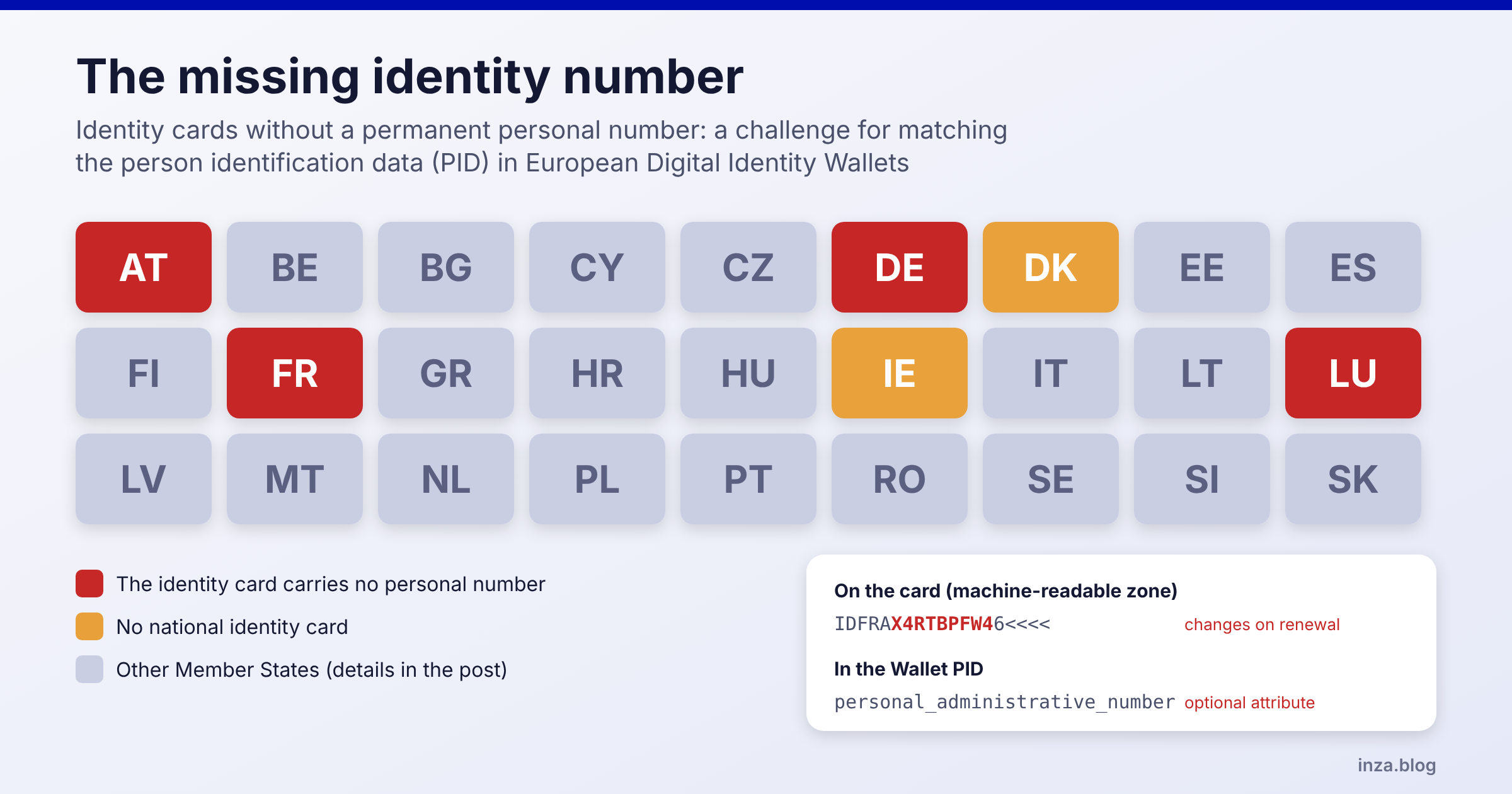
Checking the identity card specimens in PRADO, the Council’s public register of authentic identity and travel documents, shows that not every Member State prints a permanent personal number on its identity documents:
| Country | Situation |
|---|---|
| Germany | Only the document number: 9 alphanumeric characters, starting with a letter and drawn from a restricted character set, which changes on renewal. Germany has no general-purpose national identification number |
| Austria | Only the document number, 2 letters + 7 digits (e.g. PA1234567), which changes on renewal; the Austrian eID works with sector-specific identifiers |
| France | Only the document number, 9 alphanumeric characters on the card issued since 2021 (e.g. X4RTBPFW4), which changes on renewal |
| Luxembourg | A 13-digit national register number exists, but it is not printed on the card |
| Ireland and Denmark | No national identity card |
The EU has harmonised identity cards themselves: Council Regulation (EU) 2025/1208, which replaced Regulation (EU) 2019/1157 after the Court of Justice annulled it on procedural grounds, requires ID-1 cards with a machine-readable zone following ICAO Doc 9303. Cards without a functional machine-readable zone ceased to be valid on 3 August 2026. But harmonisation covers the document number, which appears in the machine-readable zone and changes with each card, not a personal number, which only some countries assign.
Cyprus shows the difference well: its card carries both a 10-digit identity card number, which is permanent, and a document number of 2 letters and 7 digits (e.g. HT0000000), which is the one in the machine-readable zone.
The reverse case also exists. In the Spanish DNI and the Portuguese Cartão de Cidadão, the document number field of the machine-readable zone holds the card (support) number, which changes with each card, while the permanent personal number goes in the optional data field. Italy has a permanent tax code (codice fiscale) alongside an electronic identity card number (2 letters + 5 digits + 2 letters, e.g. CA00000AA) that changes on renewal, and the Netherlands prints its permanent citizen service number (BSN, 9 digits) on both the identity card and the passport. A verifier reading only the document number of the machine-readable zone will therefore get a changing number even in countries that do have a permanent one.
What should be done
Member States and PID providers
- Include personal_administrative_number in the PID whenever a permanent identifier exists, even if it is not printed on the identity card.
- Where no national number exists, assign a stable, scheme-specific identifier to each citizen and publish the policy for its values, as the regulation requires.
- Never use the identity card or passport document number as personal_administrative_number: it changes with every renewal.
Trust service providers
- Use EID as the serialNumber prefix when the identifier comes from the eID scheme or the PID provider, and PNO or IDC only when it really is the national personal number or a permanent card number.
- Record in the certificate policy how the identifier was obtained, so that relying parties can interpret it.
Relying parties
- Do not assume that every PID will contain personal_administrative_number.
- For citizens of countries without one, plan a matching procedure based on the mandatory attributes, and accept that it will be less reliable.
The eIDAS 2 Regulation asks Member States to ensure the unambiguous identification of persons in cross-border situations. As long as the stable identifier remains optional in the PID, record matching will fall to each relying party, and the burden will be heaviest precisely for the citizens of the countries in the table above.
Sources
- Commission Implementing Regulation (EU) 2024/2977 on person identification data and electronic attestations of attributes issued to European Digital Identity Wallets, with its annex replaced by Implementing Regulation (EU) 2026/1731.
- Commission Implementing Regulation (EU) 2025/1943 on reference standards for qualified certificates for electronic signatures and seals.
- ETSI EN 319 412-1 V1.6.1 (2025-06), clauses 5.1.3 and 5.1.4.
- Council Regulation (EU) 2025/1208 on strengthening the security of identity cards of Union citizens.
- PRADO, Public Register of Authentic travel and identity Documents Online.
- Business registers: search for a company in the EU (EUID), European e-Justice Portal.
Related posts (in Spanish)
- Codificación de los números de identidad de los ciudadanos de la Unión Europea en los certificados, with the country-by-country table.
- El EUID de empresa es necesario para solicitar certificados QSEAL para #EPREL
- Los actos de ejecución de #eIDAS2, al día, junto con las normas ETSI y CEN que citan (bilingual)